Posts filed under ‘Education’
Kaplan on Sutton
| Peter Klein |
Here’s Steve Kaplan’s reply to Sutton, which makes several good points. The best, to me, is that Sutton et al. have no systematic evidence relating the incorporation of economics into the business-school curriculum and any particular economic or managerial outcomes. There were booms and busts, Ponzi schemes, corruption, and irrational exuberance long before “opportunism” and “agency costs” entered the MBA lexicon.I wonder what Sutton thinks caused the S&L crisis, stagflation, the Great Depresssion, the Panic of 1907, Tulip Mania, the South Sea Bubble, or any other past economic crisis? For someone who claims to favor evidence-based management, Sutton applies a pretty weak standard of evidence to his own sweeping condemnation of an entire academic discipline.
Kaplan also notes:
Sutton does not really present a viable alternative. He believes that business schools should teach the nitty gritty of leadership and organization life. The challenge in doing this is that the nitty gritty often becomes just a collection of stories or anecdotes that cannot be generalized. The advantage of economics and the other academic disciplines is that they provide general, actionable frameworks that can be applied to new circumstances. In fact, this is probably a large part of reason the economics-type analysis has crowded out some of the other areas in the social sciences.
My Question About Ward Churchill
| Peter Klein |
I haven’t followed the Ward Churchill case too closely, but was aware that last week a Denver jury ruled that he had been fired unjustly from his tenured faculty position at the University of Colorado (and presumably will be reinstated). Fabio’s post yesterday reminded me of the biggest puzzle about this whole thing: How on earth did a person without a terminal degree, with few scholarly publications, and no record of the usual academic activities (membership on journal editorial boards, leadership positions in professional societies, mentoring of graduate students, etc.) get to be a tenured full professor at a major public university?
Assuming the wikipedia entry is correct, we learn:
Churchill received his B.A. in technological communications in 1974 and M.A. in communications theory in 1975, both from Sangamon State University, now the University of Illinois at Springfield.[8] Churchill began working as an affirmative action officer at the University of Colorado at Boulder in 1978. He also lectured on Indian issues in the ethnic studies program. In 1990, he was hired as an associate professor, although he did not possess the academic doctorate usually required for such a position. The following year he was granted tenure in the communications department, without the usual six-year probationary period, after being declined by the sociology and political science departments. He was presented with an honorary Doctorate of Humane Letters from Alfred University after giving a lecture there about American Indian history in 1992. He moved to the new ethnic studies department in 1996 and was promoted to full professor in 1997. He became chair of the department in June 2002.[12][13][14]
Out of curiosity I googled his CV and found this copy (not hosted on a university site, so possibly inaccurate). There are a few items listed under “Scholarly Essays.” I’ve never heard of any of the journals (except Social Text, Stanley Fish’s journal and the hapless victim of Alan Sokal’s famous prank). Maybe they are highly ranked in the field of ethnic studies; I don’t know (but would be curious to see the impact factors).
Could someone tell me: Would this kind of academic record get someone a tenured full professorship at the University of Colorado in, say, biochemistry or political science?
Big Bucks for Coach Anderson
| Peter Klein |
In light of our recent discussions of salaries for US college coaches (1, 2), I note that Missouri basketball coach Mike Anderson, whose team lost over the weekend to the Connecticut Huskies (good thing Dick Langlois and I didn’t have a wager on that), is likely to get a big raise this year. Anderson’s base salary is $850,000, a pittance compared to Jim Calhoun’s $1.6 million. (Indeed, Anderson’s predecessor Quinn Snyder, fired at the end of the 2006 season, pulled down $1.2 million.) Local media outlets guess that at least $1.3 million will be required to keep Anderson from bolting for openings at Georgia, Virgnia, or Arizona (and Memphis, if John Calipari takes the Kentucky job). University System President Gary Forsee, Chancellor Brady Deaton, and even Missouri Governor Jay Nixon made public statements over the weekend expressing their desire to keep Anderson. Not one mentioned the University’s delicate financial situation (a huge revenue shortfall has led to cuts in academic programs, research support, faculty and staff benefits, and other expenditures). I can understand the argument for “investing” in a big-time coach but, given the recession, wouldn’t you expect campus officials to be a wee bit more discrete when tossing around these big numbers?
Selection, Meritocracy, and Educational Quality
| Dick Langlois |
We have all heard complaints about the decline in the quality of students over, say, the second half of the twentieth century. The usual interpretation is that this has to do with decline in the quality of schools, especially high schools, or in the curriculum delivered in those schools. I always like to point out to people (that is, to non-economists) that much of the perceived decline is likely a matter of demographic and selection effects. Access to secondary and higher education expanded tremendously after World War II, which changed the underlying distribution of abilities of students finishing high school and attending college. (This is also relevant to discussions of the quality of American college students versus Europeans or others — the fraction of students going on to college is higher in the U. S. than elsewhere, so comparing just the mean is misleading.) Education also became more meritocratic after the War, in that colleges and universities began to screen students by academic ability rather by other characteristics (like income).
I just ran across an interesting new paper by Lutz Hendricks and Todd Schoellman that analyzes these issues in a thorough and illuminating way. Here is the abstract:
Student Abilities During the Expansion of U.S. Education, 1950-2000
Since 1950, U.S. educational attainment has increased substantially. While the median student in 1950 dropped out of high school, the median student today attends some college. In an environment with ability heterogeneity and positive sorting between ability and school tenure, the expansion of education implies a decrease in the average ability of students conditional on school attainment. Using a calibrated model of school choice under ability heterogeneity, we investigate the quantitative impact of rising attainment on ability and measured wages. Our findings suggest that the decline in average ability depressed wages conditional on schooling by 31-58 percentage points. We also find that the entire rise in the college wage premium since 1950 can be attributed to the rising mean ability of college graduates relative to high school graduates.
This has a number of significant implications. As the authors point out, average ability has declined at all levels of schooling. This should color our interpretation of the much-touted fact that real wages haven’t increased much since 1960. At the same time, the wage gap between low and high levels of educational attainment has increased over time — because improved sorting has selected people of higher ability into college and selected people of lower ability out of college.
Funding Higher Education
| Dick Langlois |
Inspired by Peter’s post about salaries at private universities, I thought I would write a bit about public universities, notably my own. It was big news in Connecticut this week when Jim Calhoun, our head basketball coach, got nasty with a self-styled activist who attacked him at a post-game press conference. The activist, who had gotten in on a photographer’s press pass, wanted to know how Calhoun could justify his $1.6 million salary at a time of massive state deficits. Calhoun pointed out that, essentially because of him, the basketball program is a big profit maker for the University: it apparently brings in on the order of $12 million and costs about $6 million. The controversy arose because of the less-than-genteel way in which Calhoun made his case, prompting Governor Jodi Rell to issue a rebuke.
It turns out that Calhoun is not only the highest-paid University employee, he is the highest-paid State employee. (See here for a roster of the top state salaries.) The next two on the list are football coach Randy Edsall ($1.38 million) and women’s basketball coach Geno Auriemma ($1.31 million). The next three are physicians at the UConn Health Center — in the same specialties noted in the Chronicle article Peter cites: reproductive medicine, dermatology, and neurosurgery. (Basketball may not be brain surgery, but Calhoun won his 800th career game on Wednesday, and Auriemma’s team is a juggernaut likely headed for another undefeated season and a national championship.) UConn president Mike Hogan is seventh on the list. (There is an old story about the university president who was asked how he felt about making less money than the football coach: “he’s had a better year than I have,” was the answer.) (more…)
Top Earners at Private US Colleges and Universities
| Peter Klein |
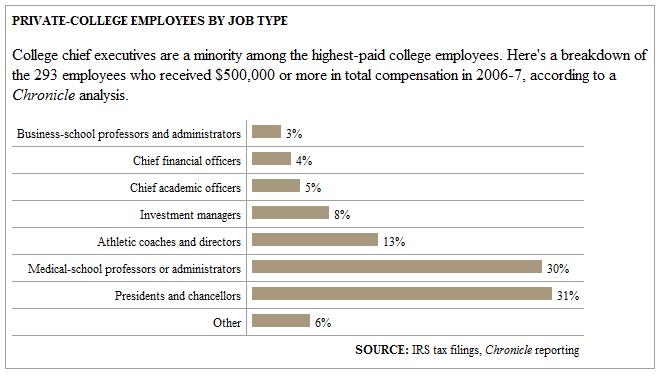
Some interesting factoids in this Chronicle of Higher Ed. story on compensation at 600 private US colleges and universities (via Gary Peters):
- Of the 88 employees earning more than $1 million in 2006-07, only 11 were chief executives. Most were coaches or medical school faculty.
- Median salary for full professors with MDs in the clinical sciences: $238,000
- Median salary for full professors in all other disciplines: $122,159
- Highest-paid employee: USC football coach Pete Carroll ($4.4 million)
- Second highest-paid employee: Columbia University dermatologist David Silvers ($4.3-million)
- Highest-paid economist: Columbia’s Henry Levin ($302,053)
- Highest-paid film-studies professor: Wesleyan’s Jeanine Basinger ($250,854)
No information given on marginal revenue products. I imagine Pete Carroll’s is at least $4.4 million. Don’t know about the rest.
See also the graphic below (click to enlarge):
The Future of the Textbook
| Peter Klein |
Cliff Kuang at Fast Company points us to smARThistory, which looks very nice, and asks:
Why the hell are we still teaching kids from textbooks? Granted, the system works. But you’d at least expect more experiments in the genre, along the lines of smARThistory. For one, textbooks for each student routinely cost hundreds, even thousands per year — and a massive chunk of those costs aren’t in the production of the material, but rather its printing and distribution. Better to give kids laptops, and dynamic textbooks with high production values (like smARThistory). You could arrange them with assigned lessons that require modules to be checked off. A system of clicks or periodic questions could ensure that the kids are engaged. And what about flash animations that illustrate physics or math concepts? The list goes on. If done right, a virtual textbook would far outshine any print textbook we’ve ever cracked.
In economics and management we sometimes use online simulations, experiments, and other interactive learning tools, but the traditional textbook (or set of journal articles) reigns supreme. Do the newer tools work? Which are most effective? And, most important, what clever names can we give them? huMANresources? pricECONnections?
Econ Courses at Open Yale
| Peter Klein |
Robert Shiller on financial markets and Ben Polak on game theory. Thanks to Joshua for the pointer and a link to Academic Earth, an aggregator for free online courses from several top US universities.
New Theoretical Developments in Strategic Management
| Mike Sykuta |
“New Theoretical Developments in Strategic Management: Opportunities for Research Contributions” is the topic of an interactive online seminar Thursday, 26 February, 12:00-1:30pm EST. The speaker is Michael Hitt, Distinguished Professor of Management and the Joe B. Foster Chair in Business Leadership and the C.W. and Dorothy Conn Chair in New Ventures at Texas A&M University. During the 90-minute seminar participants will explore theoretical developments in strategic management including the resource-based view, institutional theory, and a new concept of strategic entrepreneurship, and will offer updates on how more established theories such as TCE and agency theory are being applied.
The seminar is sponsored by the Agribusiness Economics & Management (AEM) Section of the Agricultural & Applied Economics Association (AAEA). The AEM Section has sponsored online seminars previously on topics that may be new or less familiar to its members, one of the more valuable contributions any professional society provides. Although many of the “new theoretical developments” described above may not seem quite so new to frequent O&M readers, they are certainly more novel in the context of agribusiness research.
You can register for the conference as an individual or as a host location for as many people as can fit into your local class or conference room. This is an especially good opportunity for graduate students and faculty to learn more about the research opportunities in this area. I expect several of our Missouri colleagues and grad students will be participating. Check out the conference website for information about technical requirements and registration.
Pittsburgh School Superintendent Tackles Absenteeism
| David Gerard |
Those of you that think that a football is round might not be aware that the Super Bowl is taking place this Sunday, where my hometown Pittsburgh Steelers will face the Arizona Cardinals. Every year brings its own story lines, and among the many questions surrounding this year’s game is: what is your favorite public-choice explanation for why Pittsburgh schools are opening late on Monday?
The Pittsburgh Public Schools will operate on a two-hour delay Monday because of the Super Bowl, Superintendent Mark Roosevelt said today. Noting that Sunday’s big game means a “late night,” Mr. Roosevelt said the delay should cut down on student and staff absenteeism.
Of course, not all work places are observing the delay, so this will create a few headaches for working parents who don’t happen to be teachers or staff in the Pittsburgh public school system. Perhaps Superintendent Roosevelt thinks parents will already have headaches Monday morning, so the incremental costs will be low.
Students: Consider Renting, not Buying, Your Books
| Peter Klein |
Chegg is the Netflix of college textbooks. Get your book in the mail, along with a prepaid return address label, don’t write in it too much, and send it back once the semester is over. I took a quick look and the savings appear to be substantial for brand-new books, modest otherwise (because there are robust secondary markets for used textbooks). The newest edition of a book I assigned last semester is $127 new from Amazon, $72 for a one-semester rental from Chegg. I wonder if the books come in those cute little red mailing sleeves? (Via cnet).
It Was Only a Matter of Time . . .
| Peter Klein |
. . . before someone blamed the financial crisis on agency theory. Sure enough, Raymond Fisman and Rakesh Khurana trace the source of the current mess not to expansionary monetary policy, or lax underwriting standards, or implicit (now explicit) government guarantees against market discipline, or the Basel Committee, or a host of other policy and institutional failures, but to business schools, and the critics’ favorite bête noire, the concept of shareholder wealth maximization.
[B]usiness schools [promote] a particular brand of free-market ideology — squarely focused on shareholder maximization theories — that forms the staple fare of MBA and executive education courses today. . . .
In the world views that underlie modern business education, the market always “gets prices right” and “managers” are merely agents for shareholders. An individual’s worth can be reduced to one’s worth in the market.
If I get $100 million in compensation, the thinking goes, it is because ‘I deserve it.’ There is no discussion of the role of circumstance, luck or market failure. It is the type of thinking that has resulted in literally hundreds of billions of dollars being transferred away from organizational resources and into the personal bank accounts of CEOs, and is now bringing capitalism to its knees.
So, teaching future managers how the price system works, how managerial behavior effects shareholder wealth, how marginal productivity affects wages, and the like is equivalent to encouraging managers to lie, cheat, and steal! I suppose it would be better to teach that water runs uphill, that central planning is more efficient than free markets, and that men are angels. Perhaps we should cover socially responsible statistics and accounting too.
Sumantra Ghoshal famously blamed transaction cost economics and agency theory for much of the world’s ills, including the Enron affair. At least Ghoshal offered some arguments. Fisman and Khurana can’t be bothered. (HT: Ben Asa Rast.)
Ability and Specialization Among Economic Researchers
| Peter Klein |
Forgive the navel-gazing, but some of you may enjoy Todd Kendall’s paper in the December 2008 issue of MDE, “Ability and Specialization Among Economic Researchers,” which looks at the relationship between a researcher’s human capital and the scope of his activities. The sample consists of academic economists at top-50 US universities. Kendall shows that economists from more prestigious PhD programs tend to publish in more general journals, controlling for quality, and to list more JEL subject codes per paper. The quality control is important because the most prestigious journals (as in most fields) are also the most general. But the sample includes prestigious specialty journals and lower-tier general journals.
Naturally I’m tempted to ask for the raw data so I can analyze some sub-samples containing people I know personally. But perhaps it’s better not to go there. I do plan to defend myself against charges of being “eclectic” or “unfocused” by referring to this study and calling myself a “distinguished generalist.” At least it avoids Rothbard’s Law.
Interesting Blogs
| Peter Klein |
- Urban and Regional Studies, by Pedro Marquez
- Beerkens’ Blog, by Eric Beerkens
- Estzer’s Blog, by Eszter Hargittai
- Terminal Degree, by a funny music professor
Write Like Toni Morrison
| Peter Klein |
Remember the Universal Translator? Peter Wood, in like manner, provides a useful guide to translating regular English prose into the style of Nobel-prizewinning author Toni Morrison, probably the most frequently assigned writer on US college campuses. The basic rules:
- Misuse common phrases
- Embrace inconsistency
- Omit words to create more forceful expression
- Mix up parts of speech
- Chop in self-conscious micro-sentences
He provides some wonderful examples. For instance, this office memo:
Just to remind you, I will be out of the office Tuesday to meet with our supplier, Acme Explosives. Please finish your work on the 2Q budget and let the account rep know that Mr. Coyote’s order will be shipped Thursday.
becomes
The reminding can’t wait the hurry of it. I explain. I know you know of Tuesday, I and Acme Explosives is soon together meet. You can please work, perhaps, the budget’s second quarter, and knowledge the account rep of Mr. Coyote’s Thursday shipment.
Wood also reminds us that Morrison is “the undisputed master of wandering verb tenses” and that she “knows how deftly to insert evocative foreign terms.”
But it is the anachronistic little details that are Morrison’s signature. My favorite occurs late in the book: “Ice-coated starlings clung to branches drooping with snow.” This is the 1690s, two centuries before the eccentric bird lover Eugene Schiffelin introduced starlings to the U.S. by releasing sixty of them in Central Park.
Schiffelin had no idea how the birds would proliferate, crowd out native species, and form enormous squawking, twittering, whistling flocks that seem to fill up whole forests. Starlings seem to propagate as fast as clichés and to descend like clouds of effusive blurbs on overpraised books.
Education Quote of the Day
| Peter Klein |
There is a settled mediocrity in American college teaching, surpassed here and there by talented and energetic individuals, but seldom disturbed in its languorous self-satisfaction. On most campuses, mediocrity can rightly pride itself on being a whole lot better than the conspicuous dreadfulness of a handful of professors who dedicate themselves variously to the nine muses of bad teaching: Boredom, Mumbling, Disorganization, Confusion, Forgetfulness, Stridency, PowerPoint, Textbook, and Vacuity.
That’s from Peter Wood, whose subject is actually the division of labor at many large US universities between tenured/tenure-track faculty, who do research and teach small classes to graduate and advanced undergraduate students, and the specialized, non-tenured teaching specialists who handle the bulk of the undergraduate instruction, assisted by a “small army” of graduate and undergraduate TAs. Wood points out, rightly IMHO, that one day the universities may decide that the prestige and grant dollars and other bennies generated by the research faculty isn’t worth their high salaries, perhaps choosing to go the University of Phoenix route instead.
The Impotence of the Economists, Part II
| Peter Klein |
The financial-market bailout is one thing. While most economists, rightly in my view, strongly opposed the Paulson plan, one can at least imagine intelligent arguments for it. The proposed auto-industry bailout is something else entirely. Does any economically literate person support it? Industry bailouts are textbook examples of the fallacy of composition, taught in every Econ 101 class. When I teach it I use exactly this kind of example (bailing out Chrysler in 1980, bailing out the airline and insurance industries after 9/11, etc.). Saving the X industry simply harms the Y and Z industries, while substituting the political process for the market in determining the allocation of resrouces. And yet, here we go.
Along these lines, here are some sentences to ponder from David Yermack, writing in today’s WSJ:
In 1993, the legendary economist Michael Jensen gave his presidential address to the American Finance Association. Mr. Jensen’s presentation included a ranking of which U.S. companies had made the most money-losing investments during the decade of the 1980s. The top two companies on his list were General Motors and Ford, which between them had destroyed $110 billion in capital between 1980 and 1990, according to Mr. Jensen’s calculations.
I was a student in Mr. Jensen’s business-school class around that time, and one day he put those rankings on the board and shouted “J’accuse!” He wanted his students to understand that when a company makes money-losing investments, the cost falls upon all of society. Investment capital represents our limited stock of national savings, and when companies spend it badly, our future well-being is compromised. Mr. Jensen made his presentation more than 15 years ago, and even then it seemed obvious that the right strategy for GM would be to exit the car business, because many other companies made better vehicles at lower cost. . . .
Over the past decade, the capital destruction by GM has been breathtaking, on a greater scale than documented by Mr. Jensen for the 1980s.
See also: Lynne Kiesling.
B-School Naming Rights Up to $300 million
| Peter Klein |
At Chicago, anyway, now home to the Booth School of Business.
Here’s an interesting (if slightly dated) Business Week story on B-school naming rights. Wisconsin has taken the most innovative approach, announcing earlier this year that in exchange for $85 million it would pledge not to name the school for 20 years.
Here at Organizations and Markets we are committed to honest and open inquiry, free from restrictions imposed by corporate or individual sponsors. However, if you’d like to have this blog named after yourself, we’ll toss those principles right out the window. Send all inquiries to naming-rights@organizationsandmarkets.com.
Dan and Chip Heath on Presentations
| Peter Klein |
A new entry for our PowerPoint series: Dan and Chip Heath’s “How to Avoid Making a Bad Presentation,” from the current issue of Fast Company. They’re the Made to Stick guys, in case you forgot. (Not, sadly, the people behind my all-time favorite ice cream.)
Heckman on Academia
| Peter Klein |
Steve Levitt links to this update on the travails of the University of Chicago’s proposed Milton Friedman Institute. Jim Heckman, an Institute supporter who has recently expressed public doubts about its conception and development, is on the hot seat. Heckman makes an interesting observation, in passing, that relates to a previous discussion of research funding:
Heckman added that all institutes are affected by bias, citing hiring decisions as a source of bias throughout the University.
“I doubt there is a truly unbiased academic. Besides, most biased people don’t see themselves as biased. If you think the [Chicago Graduate School of Business] is an unbiased environment, think again. They are recruited for their views. I wonder also how many free marketers would get jobs in anthropology or sociology,” he said.
“It’s true for any institute. You state a mission, attract funders. They expect the mission to be fulfilled. Very rarely do people fund pure knowledge,” he said.





 Organizations and Markets
Recent Comments