Posts filed under ‘Ephemera’

Credible Commitment
| Peter Klein | A rather extreme form of the Schelling strategy of tying one’s own hands: 
Courtesy of the indispensable Fail Blog.
2011 Ig Nobel Laureates
| Peter Klein |
The 2011 Ig Nobel Prizes were announced yesterday. No economics prize this year, but several awards recognize work with profound social-science implications. For instance:
MEDICINE PRIZE: Mirjam Tuk (of THE NETHERLANDS and the UK), Debra Trampe (of THE NETHERLANDS) and Luk Warlop (of BELGIUM). and jointly to Matthew Lewis, Peter Snyder andRobert Feldman (of the USA), Robert Pietrzak, David Darby, and Paul Maruff (of AUSTRALIA) for demonstrating that people make better decisions about some kinds of things — but worse decisions about other kinds of things‚ when they have a strong urge to urinate.
REFERENCE: “Inhibitory Spillover: Increased Urination Urgency Facilitates Impulse Control in Unrelated Domains,” Mirjam A. Tuk, Debra Trampe and Luk Warlop, Psychological Science, vol. 22, no. 5, May 2011, pp. 627-633.
REFERENCE: “The Effect of Acute Increase in Urge to Void on Cognitive Function in Healthy Adults,” Matthew S. Lewis, Peter J. Snyder, Robert H. Pietrzak, David Darby, Robert A. Feldman, Paul T. Maruff, Neurology and Urodynamics, vol. 30, no. 1, January 2011, pp. 183-7.
[ . . . ]
LITERATURE PRIZE: John Perry of Stanford University, USA, for his Theory of Structured Procrastination, which says: To be a high achiever, always work on something important, using it as a way to avoid doing something that’s even more important.
REFERENCE: “How to Procrastinate and Still Get Things Done,” John Perry, Chronicle of Higher Education, February 23, 1996. Later republished elsewhere under the title “Structured Procrastination.”
[ . . . ]
PEACE PRIZE: Arturas Zuokas, the mayor of Vilnius, LITHUANIA, for demonstrating that the problem of illegally parked luxury cars can be solved by running them over with an armored tank.
REFERENCE: VIDEO and OFFICIAL CITY INFO
What We’re Really Doing
| Lasse Lien |
I’m often at pains to describe to my family what happens at academic conferences, and why its important that I attend them. But not any longer.
For further study, check out the associated paper.
HT: Eirik S. Knudsen
My First Publication
| Peter Klein |
A colleague recently sent me a copy of his first publication, a letter to the editor in Sports Illustrated magazine. This inspired me to search for my own first publication, which was exactly the same thing. It turns out SI has made its entire archive available online, so here it is:
If it’s nostalgia Fimrite wants, I suggest he pop a few new tubes in his radio, load it into his Model T, ride to Tiger Stadium and listen to a game in the parking lot. Then he can go home, write the game up on his manual typewriter and wire his article in over the telegraph.
Funny how it often turns out that those Luddite whiners who despise large, multipurpose modern stadiums also happen to be the people with the money or the connections to get good seats in the small, cramped “traditional” parks. The rest of us will gladly give up a little tradition just to get tickets.
PETER G. KLEIN
Chapel Hill, N.C.
May 2, 1988
I was writing in reaction to this piece by SI’s Ron Fimrite. I’m still looking for an opportunity to work the term “Luddite whiners” into an academic article.
I was particularly sensitive to this issue because, during my undergraduate days at North Carolina, the school replaced the old Carmichael Auditorium with the new Dean E. Smith Center (better known as the “Dean Dome”). I appreciated the hot, poorly lit, intimate, and idiosyncratic Carmichael as much as anybody, but was tired of the two-day campouts to get student tickets, and welcomed the Dean Dome’s larger student section. Even in those days, I was sensitive to the idea of trade-offs at the margin.
The sad thing is that this letter probably had more readers than all my subsequent publications combined.
The Stresses of New Technology in Firm and Family
| Peter Lewin |
Many of the same theoretical tools and concepts that we use for the business firm are applicable to that other ubiquitous social institution, the family; though of course there are important differences (even though I am sure you know people who are “all business”). Steve Horwitz and I have written a paper that illustrates some of this.
The affects of the march of technology on the firm — for example, rendering obsolete certain kinds of physical and human capital, reducing production cost, increasing specialization and product variation, etc. — receive considerable attention. I have not seen much on these affects insude the family. Our article does analyze the long-term effects of the rising opportunity cost of labor in general and of women’s work in particular, which is the theme of a massive research literature. I have in mind rather the “mundane” effects on the family, and on the marriage, of unanticipated technological changes that, for example, affect the spouses differently. In effect, this is an unanticipated change in the marriage bargain that will plausibly bring with it additional un-bargained for stresses and tensions — an unanticipated rise in the cost of marriage (or of staying in the marriage).
I love my wife and I am not contemplating leaving, but I do feel the stress of having to perform all of the 21st century tasks for which I have a substantial comparative advantage, and which have become necessary and routine — like ordering things online, backing up data, downloading audio books (a necessity for exercising!) and so on. I wonder how common this is.
I might be in real trouble for this one :-).
Entrepreneurial Studies and Applied Economics at the AOM 2011
| Peter Lewin|
Back from the AOM 2011 meetings in San Antonio, it is worth adding a few words on the Professional Development Workshop (PDW) on Austrian Economics organized by the Henrik Berglund, Todd Chiles, and our own Peter Klein. Also there were Roggl Koppl and Maria Minniti.
I, for one, found the session extremely enjoyable and worthwhile. I am not good at estimating numbers, but I believe there were in excess of fifty people there of diverse backgrounds — all shapes and sizes. The one thing they had in common was an interest in Austrian economics as applied to entrepreneurship. Some appeared to know more about it than others, but they all seemed to be genuinely curious. Very encouraging for those of us laboring for many years on behalf of the Austrian School.
Henrik began with a nice introduction, which he later followed up with a discussion of Kirzner on entrepreneurship. Peter Klein was first up with a masterful overview of Austrian Economics for newcomers, and Todd finished up with an interesting account of Lachmann’s work drawing on his recent work. We then split into spontaneously organized small groups to discuss various topics leading to suggested research topics. The group I was in arrived at the topic “The Anatomy of Disequilibrium Order.”
As I suggest to Peter K, this might be a manifestation of a development many of us have anticipated — in a nutshell, the bifurcation of the discipline of economics. While the mainstream has moved on to ever more narrowly technical and precisely irrelevant scholarly activities, those wishing to do real economics (economics that matters for the real world) are drawn to other closely related fields. I see this developing into a kind of “applied economics.”
Academic Nepotism in Italy
| Lasse Lien |
In case you wonder the author of this paper — Stefano Allesina — works in Chicago:
Abstract: Nepotistic practices are detrimental for academia. Here I show how disciplines with a high likelihood of nepotism can be detected using standard statistical techniques based on shared last names among professors. As an example, I analyze the set of all 61,340 Italian academics. I find that nepotism is prominent in Italy, with particular disciplinary sectors being detected as especially problematic. Out of 28 disciplines, 9 – accounting for more than half of Italian professors – display a significant paucity of last names. Moreover, in most disciplines a clear north-south trend emerges, with likelihood of nepotism increasing with latitude. Even accounting for the geographic clustering of last names, I find that for many disciplines the probability of name-sharing is boosted when professors work in the same institution or sub-discipline. Using these techniques policy makers can target cuts and funding in order to promote fair practices.
Allesina, S. (2011). “Measuring Nepotism through Shared Last Names: The Case of Italian Academia.” PLoS ONE 6(8): e21160. doi:10.1371/journal.pone.0021160
No Wonder Our Readers Find Us Witty and Clever
| Peter Klein |
Confirmation bias, it appears, affects not only our scientific and political beliefs, but our aesthetic preferences as well. Now I understand why certain people read orgtheory.net!
More Serious Stuff
| Nicolai Foss |
Economists may have models of zero intelligence traders, but so far there are no models of zombie traders (that I know of). Possible inspiration for future modeling efforts here.
The Menger Sponge
| Lasse Lien |
Earlier the investigative arm of O&M (with only limited hacking of phones and bribing of police officers) discovered the sensational news that Peter is named after a bottle with no inside and no outside, the endlessly fascinating Klein bottle. Apparently this sort of thing is quite common in Austrian circles. We can now reveal that Menger is named after a sponge, the Menger sponge, which is described in greater detail here.
(Actually the Menger Sponge is named after Karl the mathematician, son of Carl.)
Old Economics Test Questions
| Peter Klein |
The University of Missouri’s sprawling new student center recently opened Mort’s, a reproduction of an old campus hangout called The Shack, made famous by Beetle Bailey creator and Mizzou alumnus Mort Walker. I snapped the photos below from the entrance to Mort’s, which is full of old Walker cartoons. I spied a 1950 cartoon featuring an economics test. Click to enlarge the strip.
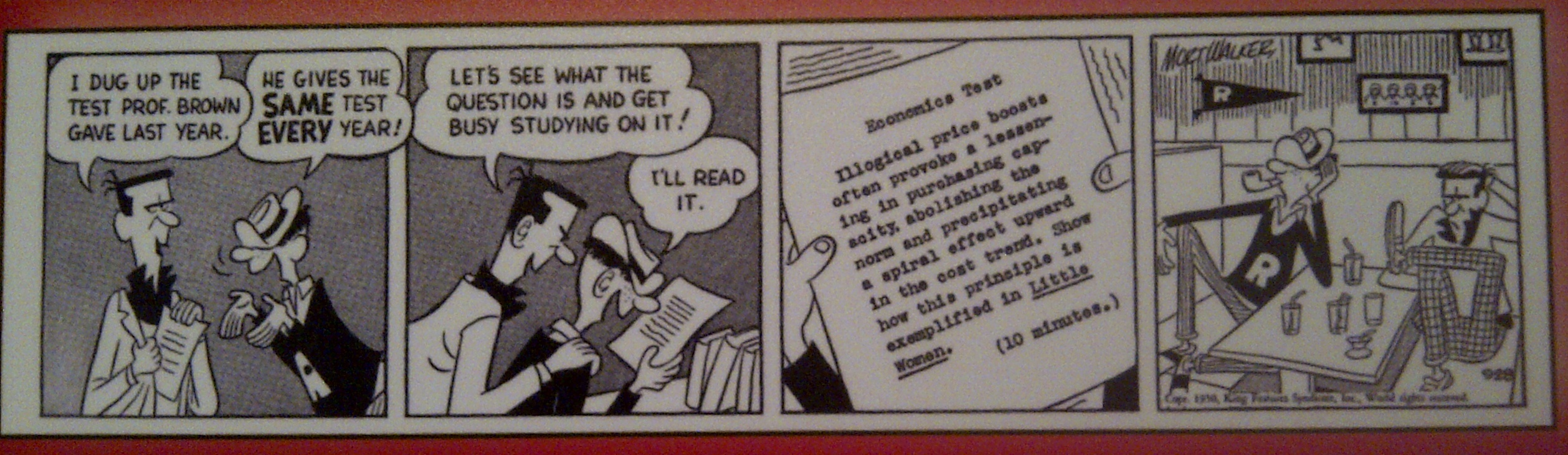
Funny, but what was Professor Brown smoking when he wrote that question? (Maybe he was just a Keynesian, bless his heart.)
Institutions and Political Economy Group
| Peter Klein |
The Institutions and Political Economy Group (IPEG) is a new research group at the University of the Witwatersrand that “promotes the study of the relationship among institutions, organizations and markets through the simple principles of economic reasoning.” Sounds good to me! IPEG is directed by O&M friend Giampaolo Garzarelli.
An Ancient Rejection Letter
| Peter Klein |
Via Josh Gans, here’s the response from Geometrika: A Most Prestigious Journal with Really Special Referees to poor Ptolemaeus, regarding his submitted paper, “An Argument that the Earth Is Round, and a Method to Determine its Circumference.” Sadly, the reviewers were not impressed, one feeling that “the idea that the Earth is round is both (i) too simple and well known to be really surprising and worth of publication, and (ii) utterly deceptive, misleading and wrong.” The editor’s skillful close:
I am sorry to bring you what must be disappointing news. Please keep in mind that we can only publish less than 8 percent of submissions. I also hope that the brilliant comments of the referees will help you to revise this paper for a submission to a more appropriate eld journal, such as Forms of Miscellaneous Objects or Maritime Inquiries.
On the bright side, I feel that you must now be in the mood of refereeing a few papers for our great journal. I will not tell you, which, if any, of the attached papers is authored by referees 1 to 3, but you can of course guess. I would have liked to receive your reports on these papers by yesterday, so you can also consider this letter as your rst reminder notice for these reports.
More on ACAC
| Peter Klein |
 About a decade ago I served a term as a Senior Economist with the Council of Economic Advisers. The Junior Economist assigned to work with me was a young Harvard PhD student named Dan Elfenbein. Dan turned out to be not only the brawn, but the brains of the partnership as well. (He may have had me in the looks department too.) Dan has gone on to do great things at Washington University and I was delighted to see him receive the ACAC Best Paper Award yesterday for his joint work with Anne Marie Knott, “No Exit: Failure to Exit under Uncertainty.” Here’s the abstract:
Delayed exit is a substantial economic problem. Studies indicate if VCs exited ventures optimally, returns would triple, and if corporations divested underperforming business units, shareholder wealth would increase 13.6%. A prevalent explanation for delayed exit is behavioral biases associated with escalated commitment. In general however exit will exhibit inertia even absent bias. This arises both from decision maker efforts to avoid Type I error while discovering the long run prospects of an endeavor (passive learning) and from the option value of exit. Solutions to exit delays differ depending upon which source predominates, yet empirical tests to date have not disentangled the relative importance of these sources. We characterize exit delay in the population of U.S. banks between 1984 and 1997, and examine its causes. We find that a substantial proportion of exit occurs beyond “rational” benchmarks that incorporate option value. While the bulk of this delay appears to represent efforts to minimize Type I error, there is also evidence of the behavioral biases associated with escalated commitment.
As noted by Bill Bogner at the awards seminar, this makes Dan the only two-time winner of this important award.
Also at ACAC: A fascinating address by Joel Baum about the intellectual history of two strands of literature, one on competitive advantage and one on network advantage. It turns out these strands share a common intellectual heritage, one I’ll have more to say about later. (Hint: the University of Vienna plays a critical role.) Rebecca Henderson also gave an excellent talk about the role played by relational contracts within firms (from a joint research project with Bob Gibbons, the leading authority on relational contracting). Relational contracts are often seen as more flexible and adaptive than formal contracts but, as Rebecca pointed out, it is difficult for managers to implement strategic changes when they cannot commit to explicit rewards and punishments — hence relational contracting may impede the adoption of superior work practices (such as the Toyota Production System). Look for a forthcoming Gibbons-Henderson paper in Organization Science spelling this out.
Economist Quote of the Day
| Peter Klein |
Arthur Goldhammer on the upcoming French elections:
This will be Dominique Strauss-Kahn’s challenge, since he will be running, if he runs, in part on his credentials as an economist. He has to make sure that this word means something other than “scold” or, worse, “tool of capital.”
I would imagine that heading the IMF is not a particularly popular launching point for the Presidency either. In other countries being a leader of the Socialist Part might hurt but, well, this is France.
Google as Emergent Organization?
| Peter Klein |
People are going to do what they are going to do, and you’re there to assist them. They don’t need me, they are going to do it anyway. They are going to do it for their whole lives. Maybe they could use a little help from me. At Google, we give the impression of not managing the company because we don’t really. It sort of has its own borg-like quality if you will. It sort of just moves forward.
This quote from Google CEO Eric Schmidt is getting some buzz (e.g., Phil Bowermaster, via Ewin Barnett). It gives the impression of a wikified firm, or an emergent organization (to use Hayekian terminology). Indeed, Google makes extensive use of teams, information sharing, and delegation, and the firm has a fairly flat organizational structure. The “Ten Golden Rules” internal document, written in 2005 by Schmidt and Hal Varian (and quoted in the Google HBS case), says “the role of the manager is that of an aggregator of viewpoints, not the dictator of decisions.” But there are decisions, and management, like George W. Bush, is the Decider. As with 3M, Google allows engineers to spend 20 percent of their time on their own projects. Still, these projects are subject to approval and monitoring. After all, the Borg believe in tight coordination!
“Entrepreneurship and the Economic Theory of the Firm”
| Peter Klein |
That’s the title of my recent CORS lecture at the University of São Paulo. You can watch the whole thing here. (Hopefully, clicking on the link will save the .wmv file to your computer or start playing the file in a media application.)

O&M Five-Year Anniversary
 | Peter Klein |
O&M went live exactly five years ago, 25 April 2006. Since then we’ve run 2,549 posts and hosted 7,375 comments, most of them insightful and informative. How to celebrate? We are not as self-aggrandizing as some, so here’s a low-key approach. First, the all-time most popular posts, in descending order:
- Management Journal Impact Factors 2008
- PhD Candidate Shortage in Accounting
- Agency Theory in Management
- Method versus Methodology
- Physics Envy and All That
- Agency Theory and Intrinsic Motivation
- 21 Economic Models Explained
- The University of Phoenix and the Economic Organization of Higher Education
- Management Journal Impact Factors 2005
- The SWOT Model May Be Wrong
- Design Puzzles
- Is Entrepreneurship a Factor of Production?
- Porter’s Five Forces, Updated
- Econ Courses at Open Yale
- Four Theories of Profit
- Summary of Dodd-Frank Act
- Market-Based Management
- Why Study the Humanities?
- Accounting: A Brief History
- Funny Professor Names
- Taxes al Carbon
- Keynesian Economics in Four Paragraphs
- The New Bashing of Economics: The Case of Management Theory
- One Part of the Financial Sector Is Still Growing
- Management Journal Impact Factors 2009
- In Praise of the US Auto Industry
- Contronymns
- How Does Management Affect Capabilities?
- Management Journal Impact Factors 2006
- March & Simon: Early Socialist Calculation Revisionists
- Do We Need a Project Project?
- Has Corporate Corruption Increased?
- Coase and the Myth of Fisher Body
- The Logic of Appropriateness
- John Nash’s Dissertation
- The History of Marketing
- The Hawthorne Effect Revisited
- What Would Hayek Say?
- Why Did the Chicken Cross the Road: Strategic Management Edition
- How to Read an Academic Article
Second, a purely subjective list of some of our favorite comments: (more…)
Biased Testing
| Lasse Lien |
The Onion asks whether tests are biased against students who don’t give a sh…. — and whether in fact the whole education system is catering to those who don’t think education is a boring waste of time.
Now that I think of it I have on several occasions noted that lazy, uninterested students tend to do systematically worse on my tests. So I am part of this unreasonable and unjust system, and I expect many O&M readers are too.
I think we should all reflect on this over the weekend.
Thanks to Eirik S. Knudsen for the pointer.





 Organizations and Markets
Recent Comments