Posts filed under ‘History of Economic and Management Thought’
2011 Spengler Prize
| Peter Klein |
Congratulations to Robert Leonard for winning the 2011 Joseph J. Spengler Prize for the best book in the history of economics for Von Neumann, Morgenstern and the Creation of Game Theory: From Chess to Social Science 1900-1960 (Cambridge University Press, 2010). I’ve only skimmed the book but it looks exceptionally well done. Required reading for O&Mers interested in intellectual history, methodology, Austrian economics, strategy, and/or game theory. . . . (That’s pretty much all of you.)
Against (Karl) Polanyi
| Peter Klein |
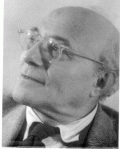 I mentioned Karl Polanyi (not to be confused with Michael) in yesterday’s post on anonymity. Gavin Kennedy points us today to Mark Pennington, who writes that Polanyi’s claims “are either historically inaccurate or based on a crude misrepresentation of classical liberalism.” Specifically,
classical liberalism has never claimed that narrowly selfish behaviour is all that is required to sustain the social fabric. Of course markets are always “embedded” in a broader nexus of institutions, but the question we need to ask is precisely what sort of institutional and social norms are required to facilitate social cooperation on the widest possible scale. Polanyi and his followers prefer to rely on hackneyed accounts of the Wealth of Nations rather than recognise that Smith’s support for markets and “self interest” constituted part of a broader ethical system set out in the Theory of Moral Sentiments. Specifically, Smith was concerned to elucidate the balance between the social norms appropriate to contexts of commercial exchange and those appropriate in more intimate environments. From Smith’s point of view feelings of sympathy which include love, friendship and reciprocity are reserved for people of whom we have detailed personal knowledge. The morals expected in commercial relations which are often between relative strangers, however, tend to be more impersonal, focussed on principles such as the observance of contracts and are oriented more towards the “self interest” of the parties involved rather than the direct benefit of “others.” The great mistake is to suppose that the type of ethos that pervades family life or that in tight knit communities can operate on a much wider scale. The development of inclusive markets requires a more impersonal ethos which enables people to engage with diverse actors who may not share the same moral outlook. If people deal only with those who share the same moral outlook or trade only with “locals” rather than engage in transactions with “foreigners” then the sphere of potentially cooperative relationships will be reduced. The alternative to self-interest is not solidarity, but suspicion if not outright conflict.
Competitive Advantage, Network Advantage, and Vienna
| Peter Klein |
At last week’s ACAC Joel Baum gave a very interesting presentation (ppt) on the institutional and intellectual histories of two important strands in management thought, the literature on competitive advantage and the literature on network advantage. These two strands developed largely in isolation but, as it turns out, can both trace important parts of their development to the University of Vienna and the Austrian school of economics. Check out the genealogies below, captured from Joel’s slides. First, two diagrams on the origins of the competitive advantage approach (click to enlarge):
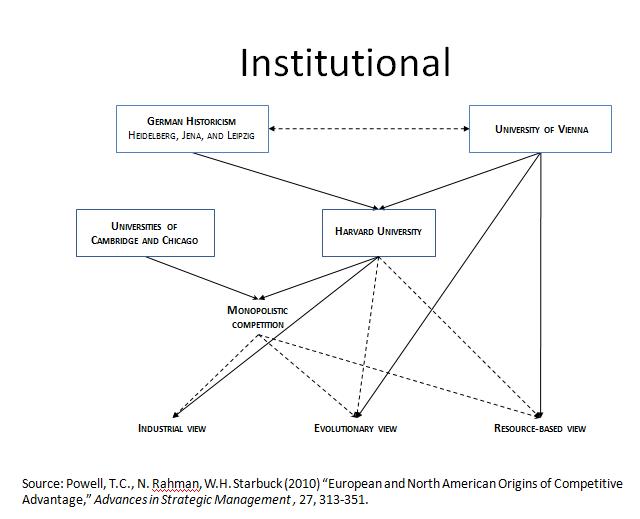

Now, two on the origins of network advantage theory: (more…)
Frank Knight and the Austrians
| Peter Klein |
At this year’s Austrian Scholars Conference I gave a presentation playfully titled “Frank H. Knight: The Forgotten Austrian.” The title was tongue-in-cheek, of course, as Knight was no Austrian. Though friendly with Hayek personally, Knight was a harsh critic of Austrian capital theory, particularly as formulated by Böhm-Bawerk and Hayek. (Knight conceived capital as a permanent fund of value, with interest determined by the technical marginal productivity of capital, rejecting notions of production structures and time preference.) Knight was also a key developer of perfect competition theory — anathema to Austrians — though mainly to illustrate the importance of uncertainty, not to serve as a welfare bechmark.
Still, there are many interesting similarities between Knightian and Austrian economics. Regular readers of O&M already know that Mises’s approach to entrepreneurship, uncertainty, and the firm is basically the same as Knight’s. Knight rejected positivism, calling it “the emotional pronouncement of value judgments condemning emotion and value judgments” (Knight, 1940). He often sounded like a Misesian praxeologist: “If anyone denies that men have interests or that ‘we’ have a considerable amount of knowledge about them, economics and its entire works will simply be to such a person what the world of color is to the blind man” (Knight, 1956). Indeed, critics dismiss Knight’s epistemological writings as “extended Austrian-style disquisitions on the foundations of human knowledge and conduct and the like” (LeRoy and Singell, 1987) — the ultimate insult! (more…)
Mitch on Hoselitz
| Peter Klein |
The following is a guest post from David Mitch, Professor of Economics at the University of Maryland, Baltimore County and an expert on Bert Hoselitz.
The reasonably recent postings on this blog on Bert Hoselitz prompt me to post a correction to my biographical piece on him for the Elgar Companion to the Chicago School of Economics (2010) edited by Ross Emmett and also to make some further comments regarding Hoselitz’ “Austrian” origins. Both the correction and futher observations stem from Yvan Kelly’s very interesting article “Mises, Morgenstern, Hoselitz, and Nash: The Austrian Connection to Early Game Theory” published in the Quarterly Journal of Austrian Economics 12, no. 3 (2009).
The correction to my piece is as follows. On p. 274 of my piece, I state that “Prominent leaders of the Austrian School of Economics such as Ludwig Mises and F. A. Hayek had departed Vienna by the time Hoselitz began his university studies.” Yvan Kelly indicates on p. 38 of his article that Hoselitz attended two of Mises’ seminars in 1933 and 1934 based on correspondence that Hoselitz sent to Mises in 1941. I have not yet seen copies of this correspondence. However, I was clearly in error in stating that Mises had departed Vienna by the time Hoselitz began his university studies. Klaus Herdzina’s (1999) biographical essay on Hoselitz cited in my piece indicates that Hoselitz studied at the University of Vienna between 1932 and 1937. I do not know from what sources Herdzina obtained this information; but I based the statement in my own piece that Hoselitz studied at the University of Vienna between 1932 and 1937 on Herdzina’s essay. Hulsmann’s 2007 biography of Mises (p. 678) indicates that Mises stopped his private seminar and left Vienna in 1934. Thus, it would appear that Hoselitz’ studies at the University of Vienna did overlap with the period that Mises was in Vienna and leading his private seminar. And this would thus be consistent with the possibility that Hoselitz attended some of Mises’ seminars. So again, the statement in my piece for the Elgar Companion that Mises had departed Vienna by the time Hoselitz started his studies at the University of Vienna would definitely seem to be in error assuming the Herdzina is correct in his dating of when Hoselitz studied at the University of Vienna. (more…)
Macroeconomics Quote of the Day
| Peter Klein |
From Mario Rizzo, who’s written a number of great posts on contemporary macroeconomic thought:
The truth is that pre-Keynesian economics was, in most ways, more sophisticated than the aggregate demand framework bequeathed to us by Keynes and his official interpreters.
Mario explains how Paul Krugman, like Keynes himself, puts forth a straw-man version of pre-Keynesian macroeconomics in which a) crises are impossible and b) only national aggregates matter. Actual pre-Keynesian macroeconomics, like today’s Austrianism, often focused on the composition of output and employment across firms, industries, and sectors. Only a few oddballs, like Foster and Catchings, the proto-Keynesian underconsumptionist theorists  skewered by Hayek in “The Paradox of Savings,” worried about economy-wide underconsumption.
See a sampler of our own thoughts on Keynes and Keynesianism here, here, and here. Or you could just watch the brilliant Keynes versus Hayek, Round 2.
Veblen at Missouri
| Peter Klein |
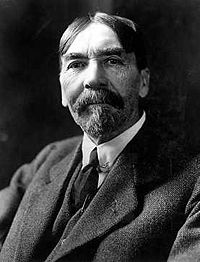 Thorstein Veblen was a professor at the University of Missouri from 1911 to 1918, following stints at Chicago and Stanford and before moving to New York to co-found the New School for Social Research with Charles Beard and John Dewey. Little has been written about Veblen’s time at Missouri, or his relationship with Herbert J. Davenport, who recruited Veblen to Missouri and provided his lodgings. (Veblen is mostly forgotten, locally, but Davenport, who founded the College of Business, is fondly remembered.)
The most detailed account of Veblen’s Missouri years (to my knowledge) appears in Russell H. Hartley and Sylvia Erickson Hartley, “In the Company of T. B. Veblen: A Narrative of Biographical Recovery” (International Journal of Politics, Culture, and Society 13, no. 2: 273-331 — the entire issue is devoted to Veblen). One snippet:
The notion that Veblen’s years in Missouri were a kind of Siberian exile which he spent as an embittered recluse seems more the fancy of academic urbanites than a reflection of actual fact. Dorfman’s puzzling assertion that Columbia “was the first country town where Veblen had stayed for any length of time” contradicts both the facts of Veblen’s life and Dorfman’s own account of those facts. By the time he settled into the Davenports’ at the end of 1910, Thors had lived thirty of his fifty-three years in rural and small-town settings. Columbia was a veritable metropolis compared with Nerstrand or Stacyville and was more than twice the size of Northfield, where he had spent six years attending Carleton.
Veblen’s reported description of Columbia as “a woodpecker hole of a town in a rotten stump called Missouri,” cited by Dorfman as evidence of his “abhorrence” of the place, reflects his wit and mordant sense of humor rather than emotional distress over his physical location. It was an offhand commentary on the local Chamber of Commerce’s campaign to elicit a promotional slogan for the Boone County seat — a remark perfectly in tune with Veblen’s views of business and the commonweal, comprehensible only in light of his analysis of American country towns generally.
More Hoselitz
| Peter Klein |
Since we first inquired about Bert Hoselitz, new information has come to light. First, we hosted a copy of Hoselitz’s hard-to-find 1951 essay “The Early History of Entrepreneurial Theory,” still the best source on the origins of economic thinking on the entrepreneur. Randy has also located Hoselitz’s rare 1963 paper “The Entrepreneurial Element of Economic Development,” which we hope to share soon.
Also, Yvan Kelly published an interesting paper in 2009, “Mises, Morgenstern, Hoselitz, and Nash: The Austrian Connection to Early Game Theory” (Quarterly Journal of Austrian Economics 12, no. 3), which provides more information. Hoselitz attended Mises’s Vienna seminar in 1933 and 1934 and, after Hoselitz emigrated to the US, Mises helped him get a position at Chicago. In 1947 Hoselitz taught a class on international economics at Carnegie Tech, where one of his students was John Nash — the only economics course Nash ever took. Notes Kelly, “there exists the distinct possibility that Nash’s thought process in formulating the [Nash] equilibrium was influenced by Austrian thought.” Kelly goes on to quote Nash’s Nobel lecture: “By coincidence the person who taught the course was someonethat came from Austria. . . . Austrian economics is like a different school than typical American or British. So by coincidence I was influenced by an Austrian economist which may have been a very good influence.” (This article by a famous blogger also deals with the Austrian connection to game theory.)
Miscellaneous Links
| Peter Klein |
- Max Weber versus Rodney Stark. Read the very interesting comment thread at this ThinkMarkets post.
- US firms can expect lower worker productivity starting this week. Duh.
- The Austrian School of Economics: A History of Its Ideas, Ambassadors, and Institutions by Eugen Maria Schulak and Herbert Unterköfler. Newly translated from the 2009 German-language original. (Translator Arlene Oost-Zinner was a production editor on my 2010 book and did a wonderful job — no cracks, please, about the need to have my stilted prose translated into passable English.)
- Do you know what really important US patent was granted on March 14?
The Forgotten: “Alternative Views of Mengerian Entrepreneurship”
| Peter Klein |
A film blog I follow, the Mubi Daily Notebook (formerly called The Auteurs Notebook) runs a regular feature called “The Forgotten,” showcasing obscure but important older titles. I propose doing the same thing here. Our first entry is a 1979 article by Dolores Tremewan Martin, “Alternative Views of Mengerian Entrepreneurship” (History of Political Economy 11, no. 2). Martin provides an excellent summary and critique of Menger’s subtle approach to the entrepreneur, one largely ignored in the current entrepreneurship literature, even among Austrian economists. Contrasting Schumpeterian and Knightian views on entrepreneurship, Martin argues that Menger’s position is close to Knight’s (and, hence, that Knight is much closer to the Austrian school than is generally recognized).
As Martin points out, Menger’s entrepreneur (Unternehmer) is a resource-owning, information-acquiring coordinator seeking to acquire and combine undervalued assets (using an “input-computing capacity”). Entrepreneurial activity is scarce, in that it is associated with ownership of scarce capital, but also “unique in that, unlike other goods of higher order, it is not intended for exchange and therefore does not command a price.” There are important differences bewteen Menger and Knight concerning types of uncertainty and the effect of uncertainty on profit. Still:
Menger does not treat the entrepreneur as being the “innovator,” “mover,” or “force of change.” Menger places stress on the entrepreneurial function and the role of uncertainty, not innovation, as giving rise to the possibility for rewards. As Schumpeter [the historian of economic thought] suggests, the economic process viewed by Carl Menger is essentially similar to that of Frank Knight. . . . For Menger (as for Knight) the entrepreneurial activity consists of a more correct — “more rational” — evaluation of goods of higher order. This view contrasts with Schumpeter’s personification of the entrepreneur as the hero of the capitalist drama.
Mario Rizzo’s Graduate Course in Behavioral Economics
| Peter Klein |
Check out the syllabus and join the discussion at ThinkMarkets. I appreciate boat-rocking as much as anyone but am personally in what Mario terms (in his syllabus) the “classical” camp. Still, this is a course I would definitely take. If he’s an easy grader.
The Vanishing Hand: 19th-Century French Edition
| Dick Langlois |
Haven’t read this yet, but it looks interesting. Note also the futuristic publication date.
On the Origins of Vertical Unbundling: The Case of the French Transportation Industry in the 19th Century
Guy Numa
European Journal of the History of Economic Thought, Vol. 20, No. 2, 2013The paper retraces the origins of the unbundling of infrastructure, which is a monopoly, from services, which are subject to competition. Using the case of the railroad industry in France, I examine how both natural monopoly theorists and legislation dealt with this subject in the 19th century. I argue that the origins of vertical unbundling date to this period with legislation pertaining to inland waterways and railroads. This was particularly the case for the railroad industry due to pricing and competition rationales. I analyze the writings of Dupuit and Walras and show that they both agreed that infrastructure and services had to be unbundled for the inland waterways. In contrast, they expressed different justifications to defend the monopoly for the railroad industry. Following a chronological progression, the first section explores the origins of unbundling in legislation. The second section analyzes how theorists approached the way railroads had to be managed. Throughout, I highlight the interplay between their work and legislation.
The AER Canon
| Lasse Lien |
The American Economic Review is celebrating its 100th anniversary and, to commemorate, Volume 101, Issue 1 names the top 20 papers during its first 100 years as judged by the following committee: Kenneth J. Arrow, B. Douglas Bernheim, Martin S. Feldstein, Daniel L. McFadden, James M. Poterba, and Robert M. Solow. The list and the committee’s justification for including each paper can be found here. The committee admits using a combination of quantitative as well as qualitative criteria, but I cannot see that the list is idiosyncratic in any particular way. A balanced and reasonable canon IMHO:
Alchian, Armen A., and Harold Demsetz. 1972. “Production, Information Costs, and Economic Organization.”American Economic Review, 62(5): 777–95.
Arrow, Kenneth J. 1963. “Uncertainty and the Welfare Economics of Medical Care.” American Economic Review, 53(5): 941–73.
Cobb, Charles W., and Paul H. Douglas. 1928. “A Theory of Production.” American Economic Review,18(1): 139–65.
Deaton, Angus S., and John Muellbauer. 1980. “An Almost Ideal Demand System.” American Economic Review, 70(3): 312–26.
Diamond, Peter A. 1965. “National Debt in a Neoclassical Growth Model.” American Economic Review, 55(5): 1126–50.
Diamond, Peter A., and James A. Mirrlees. 1971. “Optimal Taxation and Public Production I: Production Efficiency.” American Economic Review, 61(1): 8–27.
Diamond, Peter A., and James A. Mirrlees. 1971. “Optimal Taxation and Public Production II: TaxRules.” American Economic Review, 61(3): 261–78.
Dixit, Avinash K., and Joseph E. Stiglitz. 1977. “Monopolistic Competition and Optimum Product Diversity.” American Economic Review, 67(3): 297–308.
Friedman, Milton. 1968. “The Role of Monetary Policy.” American Economic Review, 58(1): 1–17.
Grossman, Sanford J., and Joseph E. Stiglitz. 1980. “On the Impossibility of Informationally Efficient Markets.” American Economic Review, 70(3): 393–408.
Harris, John R., and Michael P. Todaro. 1970. “Migration, Unemployment and Development: A Two-Sector Analysis.” American Economic Review, 60(1): 126–42.
Hayek, F. A. 1945. “The Use of Knowledge in Society.” American Economic Review, 35(4): 519–30.
Jorgenson, Dale W. 1963. “Capital Theory and Investment Behavior.” American Economic Review, 53(2): 247–59.
Krueger, Anne O. 1974. “The Political Economy of the Rent-Seeking Society.” American Economic Review, 64(3): 291–303.
Krugman, Paul. 1980. “Scale Economies, Product Differentiation, and the Pattern of Trade.” American Economic Review, 70(5): 950–59.
Kuznets, Simon. 1955. “Economic Growth and Income Inequality.” American Economic Review, 45(1): 1–28.
Lucas, Robert E., Jr. 1973. “Some International Evidence on Output-Inflation Tradeoffs.” American Economic Review, 63(3): 326–34.
Modigliani, Franco, and Merton H. Miller. 1958. “The Cost of Capital, Corporation Finance and the Theory of Investment.” American Economic Review, 48(3): 261–97.
Mundell, Robert A. 1961. “A Theory of Optimum Currency Areas.” American Economic Review,51(4): 657–65.
Ross, Stephen A. 1973. “The Economic Theory of Agency: The Principal’s Problem.” American Economic Review, 63(2): 134–39.
Shiller, Robert J. 1981. “Do Stock Prices Move Too Much to Be Justified by Subsequent Changes in Dividends?” American Economic Review, 71(3): 421–36.
CFP: Hayek and Behavioral Economics
| Peter Klein |
Forwarded on behalf of Roger Frantz:
CALLL FOR PAPERS
“Hayek and Behavioural Economics” (2011). Palgrave Macmillan. Vol 4 of Archival Insights into the Evolution of Economics. Robert Leeson Series Editor. Vol 4 editors, Roger Frantz and Robert Leeson.
Papers on all aspects of Hayek’s work as it relates to behavioral economics defined broadly which includes but not limited to economics and psychology, neuroeconomics, and topics in the history of economic thought.
Papers will be due by the summer of 2011. Send inquiries and an abstract to Roger Frantz (rfrantz@mail.sdsu.edu) or Robert Leeson (rleeson@stanford.edu).
History of Economic Thought Revival?
| Peter Klein |
More on the AEA meetings: I didn’t attend enough sessions to get a feel for overall directions and trends, but David Warsh (via Lynne) detected a revival of interest in the history of economic thought:
Interesting, too, was the undercurrent to be found in many conversations of interest in the history of economics itself. History of economic thought — or history of science, if you prefer — is a subject that has all but disappeared in the last thirty years as a topic of major research interest or as a subject of courses in top graduate schools — precisely the period of economic triumphalism.
I certainly can’t prove a resurgence of interest in economics past as it bears upon the present, or even document it beyond a few suggestive facts. The history of thought sessions in the meetings proceeded in their customary grooves — a retrospective on the rational expectations assumption fifty years after it was introduced, Irving Fisher’s The Purchasing Power of Money at one hundred.
But there were portents of change in at least one session on “rethinking the core” of graduate education. James Heckman, of the University of Chicago, endorsed the possibility of restoring to the graduate curriculum high-level elective courses in the history of economic thought. “People in the past were smart and they made mistakes and had insights,” he said afterwards. “We have sometimes forgotten the insights and we have sometimes repeated the same mistakes.”
An interesting challenge to what Murray Rothbard called the “Whig theory” of science, the view that dominates contemporary research in most of the social sciences.
Why Do Bad Ideas Spread? Luzzetti and Ohanian on the Rise and Fall of Keynesianism
| Peter Klein |
O&M generally takes a dim view of Keynesian economics. And yet Keynesianism triumphed after WWII and, while mostly dormant among academics from the 1970s to the 2000s, made a sweeping comeback over the last 2-3 years. If we anti-Keynesians are so smart, why is Keynesianism so popular?
This is an important question for the history, philosophy, and sociology of science, and we’ve addressed it before. Keynesianism appeals to fine-tuners, is easily formalized, appeared to “work” during and after WWII, has a “progressive” and “scientific” veneer, and justifies policies that governments have long championed (but all serious economists opposed).
Matthew Luzzetti and Lee Ohanian propose a similar narrative in their new NBER paper, “The General Theory of Employment, Interest, and Money After 75 Years: The Importance of Being in the Right Place at the Right Time.” In a nutshell, Keynesianism told people what they wanted to hear, gave them hope that the “new” economics could cure the Depression and bring long-term prosperity, worked well with the new empirical methods appearing in the 1940s and 1950s, and seemed consistent with observation. By the 1970s, however, the situation became almost reversed, and Keynesianism was dumped by the research community. Here’s an excerpt from the introduction: (more…)
The Economist on Coase at 100
| Peter Klein |
 The new Economist celebrates Ronald Coase’s 100th birthday (this coming Wednesday) with a short piece on “The Nature of the Firm” (1937), the founding document of modern organizational economics (16,379 Google Scholar cites). (Thanks to Avi for the pointer.) It’s nice to see the theory of the firm get its props, and the first few paragraphs do a good job summarizing the paper. But the (anonymous) author has misread the modern literature, first in setting up an artificial conflict between Coase’s transaction-cost approach and the resource-based approach to the firm and, second, by missing the depth and nuance of Coase’s own research program.
 On the first point: Much recent work tries to reconcile transaction cost economics (TCE) and the resource-based view (RBV) (e.g., Silverman, 1999; Foss and Langlois, 1999; Tsang, 2000; Madhok, 2002; Foss and Foss, 2005), pointing out that the two theories are, in important ways, complementary. Put simply: TCE and RBV start with different explananda. The RBV asks which resources will be combined in which ways to produce which outputs, while TCE asks how this activity will be organized (market, hierarchy, or hybrid). RBV offers a theory of competitive advantage, while TCE focuses on boundaries and governance. Second, the Economist writer confuses Coase with the (Coase-inspired) transaction cost approach of Williamson (1971, 1975, 1979) and Klein, Crawford, and Alchian (1978): (more…)
Kiffin Goods
| Peter Klein |
US college football fans may appreciate this paper, written by three University of Tennessee economists:
Kiffin Goods
by Omer Bayar, William Neilson, and Stephen Ogden
February 2, 2010Abstract: In this paper, we investigate the possibility of a managerial input that experiences increasing compensation along with decreasing intensity. We call this type of input a “Kiffin Good” after the head football coach Lane Kiffin. We propose a novel production process that might lead to Kiffin behavior.
The Kiffin Good is described as the supply-side equivalent of the so-called Giffen Good — for the latter, the quantity demanded increases with price, while for the former, price rises as quantity falls. (Note that some of us have politically incorrect views on Mr. Giffen’s famous paradox.)
CFP: “Competition, Innovation and Rivalry”
| Peter Klein |
The European Society for the History of Economic Thought (ESHET) is having its 15th annual meeting 19-22 May 2011 at Bogazici University, Istanbul. A special themed section, headlined by keynoters (and O&M friends) Dick Nelson and Stavros Ioannides, is “Competition, Innovation and Rivalry”:
The way in which innovation has been described, categorised, contextualised and theorised by various figures as well as schools of thought in the discipline of economics warrants a thorough investigation from a history of economic thought perspective. Although it is a truism that some approaches in economics by focusing on the conditions of allocating resources efficiently within a static framework failed to consider innovation properly, other approaches by underscoring the evolutionary characteristics of the economy, and thus by paying attention to dynamic efficiency, aimed at shedding light on innovation in an explicit manner. Knowledge and entrepreneurship standing as natural ingredients of innovation, much debate has been devoted to the roles played by competition, rivalry and collaboration among economic actors. A corollary of this debate has been on the characterisation of different economic systems in boosting or hampering innovation. . . . We are interested in papers that expose the history of economic ideas concerning innovation, competition and rivalry as well as papers that provide a historical or methodological perspective concerning methodological, ideological and political debates which evolved around these concepts.
Abstracts are due 15 December; see the above link for details.





 Organizations and Markets
Recent Comments