Posts filed under ‘– Klein –’
Mahoney Invested as Caterpillar Chair
| Peter Klein |
Congratulations to O&M friend and former guest blogger Joe Mahoney for his investiture as the Caterpillar Chair in Business at the University of Illinois at Urbana-Champaign. Here is the official announcement, which includes the following summary of Joe’s many accomplishments:
Joseph T. Mahoney is a professor of business administration at the University of Illinois who specializes in corporate governance and organizational economics. He is an editor for several top management journals, a prolific author, frequent advisor to Ph.D. candidates, and a professional consultant. For more than 20 years Mahoney has been an award winning teacher to undergraduates, MBAs and other graduate students. He holds a B.A. in Economics from the University of Pennsylvania, and M.S. and Ph.D. degrees in Business Economics from the Wharton School of Business.
Joseph Mahoney has published more than 50 scholarly articles in respected journals like the Academy of Management Review, Journal of Management, Journal of Management Studies, and Strategic Management Journal. His publications have been cited over 5,600 times by scholars in 65 countries. His book, Economic Foundations of Strategy has been adopted by over 30 top doctoral programs. Mahoney is an editor for the International Journal of Strategic Change Management and the Strategic Management Journal, and he contributes to 21 additional journals. Mahoney’s passionate teaching has garnered him many outstanding teacher awards since coming to Illinois in 1988. In that time he also served on 47 completed doctoral dissertation committees and currently serves on 8 others that are in progress.
You may recall that Joe is also this year’s recipient of the Academy of Management’s Irwin Award. Way to go, Joe!
Veblen at Missouri
| Peter Klein |
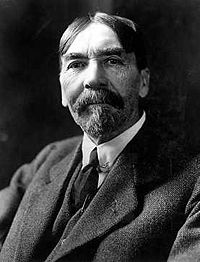 Thorstein Veblen was a professor at the University of Missouri from 1911 to 1918, following stints at Chicago and Stanford and before moving to New York to co-found the New School for Social Research with Charles Beard and John Dewey. Little has been written about Veblen’s time at Missouri, or his relationship with Herbert J. Davenport, who recruited Veblen to Missouri and provided his lodgings. (Veblen is mostly forgotten, locally, but Davenport, who founded the College of Business, is fondly remembered.)
The most detailed account of Veblen’s Missouri years (to my knowledge) appears in Russell H. Hartley and Sylvia Erickson Hartley, “In the Company of T. B. Veblen: A Narrative of Biographical Recovery” (International Journal of Politics, Culture, and Society 13, no. 2: 273-331 — the entire issue is devoted to Veblen). One snippet:
The notion that Veblen’s years in Missouri were a kind of Siberian exile which he spent as an embittered recluse seems more the fancy of academic urbanites than a reflection of actual fact. Dorfman’s puzzling assertion that Columbia “was the first country town where Veblen had stayed for any length of time” contradicts both the facts of Veblen’s life and Dorfman’s own account of those facts. By the time he settled into the Davenports’ at the end of 1910, Thors had lived thirty of his fifty-three years in rural and small-town settings. Columbia was a veritable metropolis compared with Nerstrand or Stacyville and was more than twice the size of Northfield, where he had spent six years attending Carleton.
Veblen’s reported description of Columbia as “a woodpecker hole of a town in a rotten stump called Missouri,” cited by Dorfman as evidence of his “abhorrence” of the place, reflects his wit and mordant sense of humor rather than emotional distress over his physical location. It was an offhand commentary on the local Chamber of Commerce’s campaign to elicit a promotional slogan for the Boone County seat — a remark perfectly in tune with Veblen’s views of business and the commonweal, comprehensible only in light of his analysis of American country towns generally.
Sociology Major Reads First Book
| Peter Klein |
Interesting item from a Sports Illustrated profile on Connecticut star Kemba Walker (via Jason Fertig):
Last spring [Kemba] Walker approached UConn academic counselor Felicia Crump and asked her to help him figure out how to earn his degree in sociology so that he could enter the draft this year and still graduate. Together they built a schedule that required Walker to take courses last summer in Storrs and then a full load in both the fall and the spring. . . .
Walker took schoolwork with him throughout the Big East and NCAA tournaments, completing short required papers while postponing tests until after the season. He met with his campus tutor on Skype. And in his travel pack is a copy of New York Times columnist William C. Rhoden’s Forty Million Dollar Slaves: The Rise, Fall, and Redemption of the Black Athlete, a book that Crump encouraged Walker to read as part of an independent study class on racism in sports. Before the Final Four, Crump suggested that Rhoden’s book would be the first that Walker had ever made it through cover-to-cover. After the win over Kentucky, Walker confirmed this. “That’s true,” he said. “You can write that. It is the first book I’ve ever read.”
Actually UConn has had some excellent students on its men’s basketball team (such as Emeka Okafor who, Dick tells me, graduated from the UConn Honors Program in three years with a 3.7 GPA in finance).
Anyway, I started posting this to have a bit of fun with our friends from the other side of the aisle. Then I realized that many economics and management majors probably haven’t read any books.
Who Benefits from Coups?
| Peter Klein |
Not surprisingly — private interests:
Coups, Corporations, and Classified Information
Arindrajit Dube, Ethan Kaplan, Suresh Naidu
NBER Working Paper No. 16952, April 2011We estimate the impact of coups and top-secret coup authorizations on asset prices of partially nationalized multinational companies that stood to benefit from US-backed coups. Stock returns of highly exposed firms reacted to coup authorizations classified as top-secret. The average cumulative abnormal return to a coup authorization was 9% over 4 days for a fully nationalized company, rising to more than 13% over sixteen days. Pre-coup authorizations accounted for a larger share of stock price increases than the actual coup events themselves.There is no effect in the case of the widely publicized, poorly executed Cuban operations, consistent with abnormal returns to coup authorizations reflecting credible private information. We also introduce two new intuitive and easy to implement nonparametric tests that do not rely on asymptotic justifications.
In what can only be a pure coincidence, the following item appeared just below the NBER paper in my RSS reader: “Halliburton Profit More Than Doubles.”
Missouri Corporate Governance Conference
| Peter Klein |
The University of Missouri’s Trulaske College of Business, Division of Applied Social Sciences, and School of Law are jointly hosting an interdisciplinary conference on corporate governance, 19-21 May 2011 in Columbia, Missouri: “Corporate Governance: The Role of the Board of Directors in Understanding and Managing Disruptive and Transformational Technologies.” Keynote speakers include Renee Adams, Ed Zajac, David Haffner, and Tom Melzer. Check the link above for registration, accommodation, and other information.
CFP: Economics and Strategy of Entrepreneurship and Innovation
| Peter Klein |
Forwarded on behalf of Dan Spulber:
CALL FOR PAPERS
Journal of Economics & Management Strategy (JEMS)
Economics and Strategy of Entrepreneurship and Innovation IIIJEMS is planning a third special issue on the economics and strategy of entrepreneurship and innovation. JEMS welcomes both empirical and theoretical contributions.
Possible topics include:
- Economics of entrepreneurship
- Innovation and entrepreneurship
- R&D and the entrepreneur
- Intellectual property rights and the entrepreneur
- Entrepreneurship and the theory of the firm
- Entrepreneurship and finance
- Entrepreneurship and industrial organization
- Entrepreneurship and economic growth
Submissions to JEMS will be subject to the standard peer-review process. The submission deadline is July 1, 2011. To submit a manuscript to JEMS, visit ScholarOne at http://mc.manuscriptcentral.com/jems. If you have any questions about JEMS, please contact Susie Caruso at editjems@kellogg.northwestern.edu.
Humanoid Resource Management
| Peter Klein |
I can’t quite tell if this “Schumpeter” column, urging management scholars to think more carefully about “homo-robo relations,” is meant to be taken seriously. It gave me a few chuckles, anyway.
Until now executives have largely ignored robots, regarding them as an engineering rather than a management problem. This cannot go on: robots are becoming too powerful and ubiquitous. Companies may need to rethink their strategies as they gain access to these new sorts of workers. Do they really need to outsource production to China, for example, when they have clever machines that work ceaselessly without pay? They certainly need to rethink their human-resources policies — starting by questioning whether they should have departments devoted to purely human resources.
And what about robo-agency theory? Can robots be programmed to be intrinsically motivated — finally rendering certain management theories intelligible — or do they respond to incentives in a predictable way? Are they risk averse? Will they behave opportunistically? Can they be “nudged” by clever behavioral economists?
Actually the article does make some serious points, e.g., economists and management scholars should prepare for an onslaught of neo-Luddite, anti-automation, protectionist gibberish about robots “taking away our jobs.” (Maybe if they’re domestically made robots it will be OK?)
4 Percent Project
| Peter Klein |
 On the way back from Brazil I will stop in Dallas to speak on entrepreneurship at a conference on economic growth, The 4 Percent Project, sponsored by the newly formed George W. Bush Presidential Center. The main speakers include four Nobel Laureates (Becker, Lucas, Scholes, Prescott), Ed Lazear, Allan Meltzer, Meg Whitman, Art Laffer, and W himself. I’m on a breakout panel with Bob Litan, Maria Minniti, and Jeff Friedman. The conference is the brainchild of O&M friend John Chapman, and should be quite an event!
More Hoselitz
| Peter Klein |
Since we first inquired about Bert Hoselitz, new information has come to light. First, we hosted a copy of Hoselitz’s hard-to-find 1951 essay “The Early History of Entrepreneurial Theory,” still the best source on the origins of economic thinking on the entrepreneur. Randy has also located Hoselitz’s rare 1963 paper “The Entrepreneurial Element of Economic Development,” which we hope to share soon.
Also, Yvan Kelly published an interesting paper in 2009, “Mises, Morgenstern, Hoselitz, and Nash: The Austrian Connection to Early Game Theory” (Quarterly Journal of Austrian Economics 12, no. 3), which provides more information. Hoselitz attended Mises’s Vienna seminar in 1933 and 1934 and, after Hoselitz emigrated to the US, Mises helped him get a position at Chicago. In 1947 Hoselitz taught a class on international economics at Carnegie Tech, where one of his students was John Nash — the only economics course Nash ever took. Notes Kelly, “there exists the distinct possibility that Nash’s thought process in formulating the [Nash] equilibrium was influenced by Austrian thought.” Kelly goes on to quote Nash’s Nobel lecture: “By coincidence the person who taught the course was someonethat came from Austria. . . . Austrian economics is like a different school than typical American or British. So by coincidence I was influenced by an Austrian economist which may have been a very good influence.” (This article by a famous blogger also deals with the Austrian connection to game theory.)
Why Do Firms Hire Management Consultants?
| Peter Klein |
 Academic economists and management scholars are often skeptical of management consulting firms. Their advice seems fluffy, ad hoc, unscientific. But consulting firms continue to prosper. Are their clients irrational?
I always assumed signaling plays a role. One can imagine a Spence-style separating equilibrium in which high-quality firms signal their unobservable characteristics to customers, suppliers, rivals, etc. by hiring an expensive consulting firm, while low-quality firms find this prohibitively costly. Of course, all consulting firms are not alike, and there are many different types of consulting services (e.g., strategy — more fluffy; IT implementation — less fluffy).
An article in the new JMS by Donald Bergh and Patrick Gibbons looks at the signaling value of consulting, measuring the stock-market reactions to firms’ announcements of hiring a consulting firm. Excess returns are positive and significant, and increasing in the client’s prior performance — the market likes it when “good” firms hire consultants. (The effects don’t seem to depend on the reputation of the consulting firm, though.) This is consistent with my story above, though we’d need to know something about firms that could have hired a consultant but didn’t to say more.
CORS Lecture and Mises Brazil
| Peter Klein |
O&Mers in Brazil, come see me at two events this week. Thursday, 7 April, I will deliver the inaugural CORS Lecture at the University of São Paulo on “Entrepreneurship, Strategy, and Public Policy.” CORS, the Center for Organization Studies, is a new institute organized by O&M friends Sylvia Saes and Decio Zylbersztajn and involving many scholars familiar to O&M readers. The lecture is co-sponsored by the Mises Institute Brazil, my main host for the trip, and I will speak at the Institute’s Second Conference on Austrian Economics 9-10 April in Porto Alegre, along with Hans-Hermann Hoppe, Robert Murphy, Guido Hülsmann, Gabriel Zanotti, Ubiratan Iorio, Antony Mueller, Fabio Barbieri, and Dalton Gardimam. I’ll give one talk on entrepreneurship and another on networks. I would love to see you at one of these events!
Recycling an Old Post
| Peter Klein |
These important announcements appeared originally April 1, 2007.
Foss, Klein, Postrel Join Harvard Faculty
Nicolai, Steve, and I are pleased to announce that we have accepted chaired positions at Harvard University:
Cambridge, Mass., April 1, 2007 — World-renowned scholars Nicolai J. Foss, Peter G. Klein, and Steven R. Postrel will join the Harvard faculty as University Distinguished Professors and co-directors of the newly formed Long Tail Institute for the Global Economy. Says incoming President Drew Faust: “I am delighted that Professors Foss, Klein, and Postrel are joining our team. I have always admired Foss and Klein’s work on judgment-based entrepreneurship, and I enjoyed Postrel’s columns in the New York Times before he changed his name to ‘Steve.’ After reading their blog I knew they were the ones to lead Harvard into the global information age.”
Announcing Guest Bloggers Jeff Pfeffer and Bob Sutton
We’re delighted to welcome Stanford University professors Jeff Pfeffer and Bob Sutton as our newest guest bloggers. Sutton writes: “Jeff and I have recently come out of what we call our ‘Blue Period,’ characterized by moodiness and irritability toward toward economists. We now realize that economic analysis is vital to the proper understanding of organizations. What better way to flaunt our new perspective than by joining the outstanding bloggers at Organizations and Markets? We’ll also be working on our new book, Not Ready to Make Nice in the Workplace.” Welcome, Jeff and Bob!
Google Acquires O&M
This hit the news wires today:
Mountain View, April 1, 2007 — Google Corporation announced today it has acquired a majority stake in the weblog Organizations and Markets, a leading provider of news and information on organizations, strategy, entrepreneurship, and anti-postmodernism. Google CEO Larry Schmidt noted that Google is seeking to expand beyond the search-engine business. “Let’s face it, search is yesterday’s technology. There’s too much junk out there. Instead of using computers to sort our information with confusing page-ranking algorithms, the time has come to hire experts to tell us what the world is really like. The authors of Organizations and Markets are just the experts we’ve been looking for.” Google shares dropped 42% in heavy trading upon the announcement.
Here are some important April 1 stories from prior years.
Confusing Definitions of Entrepreneurship
| Peter Klein |
Some of you have heard me complain before about the confusing ways “entrepreneur” and its cognates are used in the literature. Sometimes entrepreneurship refers to an outcome or phenomenon (startups, self-employment, high-growth firms), other times to a behavior or attribute (creativity, alertness, innovation, judgment, adaptation). I find the occupational, structural, and functional taxonomy useful, but other organizing schemes may be useful too. In any case, reading the entrepreneurship literature can be a frustrating experience.
I’m glad I’m not the only one who thinks so:
[T]he book’s diversity of approaches and styles is both a strength and also an inherent weakness. Some chapters offer comprehensive descriptions over long periods of time (e.g., Hudson, Hau, Wengenroth, Chan), while others focus on narrow aspects of entrepreneurship (e.g., Yonekura and Shimizu, Mokyr, Wolcott). The first kind appears to be written for a broad audience of noneconomic historians, whereas the second type tends to be drier and more technical. Some authors follow Baumol and distinguish between productive and redistributive entrepreneurship (e.g., Hudson, Mokyr, Cain, Lamoreaux), while others use very broad definitions of entrepreneurship (e.g., Kuran, Casson and Godley, Gelderblom), and yet another group of authors associates entrepreneurship with innovation (e.g., Yonekura and Shimizu, Graham). This extreme diversity of definitions and approaches can overwhelm the reader. As a result, the volume’s ambition of tracing “the history of entrepreneurship throughout the world since antiquity” (p. vii) ends up being an interesting patchwork of insights drawn from different times and places rather than a unifying and synthetic history.
That’s from Michaël Bikard and Scott Stern’s Journal of Economic Literature review of The Invention of Enterprise: Entrepreneurship from Ancient Mesopotamia to Modern Times (ed. David S. Landes, Joel Mokyr, and William J. Baumol, Princeton, 2010), which we blogged about earlier. Obviously in a work of this scope, a common definition of entrepreneurship is likely to be elusive. But the wide variety of meanings in this lone volume give you a sense of the challenge in making sense of the wider literature.
FAIL
| Peter Klein |
Check out AdmittingFailure.com,
an open space for development professionals who recognize that the only “bad” failure is one that’s repeated. Those who are willing to share their missteps to ensure they don’t happen again. It is a community and a resource, all designed to establish new levels of transparency, collaboration, and innovation within the development sector.
Thanks to Josh Gans for the tip and some interesting discussion of failure in other contexts. (I’m not sure I’d use the term “missing market,” though; M&As, bankruptcy court, and indeed any asset markets could be described as markets for failure!)
Here’s an interesting paper by Rita McGrath on entrepreneurial failure. And of course there are huge academic literatures on divestitures, bankruptcies, and the like. At O&M we’ve often criticized bailouts and stimulus policy for retarding Schumpeterian competition by making it more difficult to identify, rectify, and learn from failures.
Information versus Knowledge
| Peter Klein |
[T]here’s enough information coming at us from all sides to leave us feeling overwhelmed, just as people in earlier ages felt smothered by what Leibniz called “that horrible mass of books that keeps on growing.” In response, 17th-century writers compiled indexes, bibliographies, compendiums and encyclopedias to winnow out the chaff. Contemplating the problem of turning information into useful knowledge, Gleick sees a similar role for blogs and aggregators, syntheses like Wikipedia, and the “vast, collaborative filter” of our connectivity. Now, as at any moment of technological disruption, he writes, “the old ways of organizing knowledge no longer work.”
But knowledge isn’t simply information that has been vetted and made comprehensible. “Medical information,” for example, evokes the flood of hits that appear when you do a Google search for “back pain” or “vitamin D.” “Medical knowledge,” on the other hand, evokes the fabric of institutions and communities that are responsible for creating, curating and diffusing what is known. In fact, you could argue that the most important role of search engines is to locate the online outcroppings of “the old ways of organizing knowledge” that we still depend on, like the N.I.H., the S.E.C., the O.E.D., the BBC, the N.Y.P.L. and ESPN.
That’s Geoffrey Nunberg reviewing James Gleick’s new book, The Information (Random House, 2011). Gleick burst onto the scene with 1987’s Chaos: The Making of New Science, which introduced the butterfly effect, Mandelbrot sets, fractal geometry, and the like into popular culture. (Don’t blame Gleick for the silly Ian Malcolm character in Jurassic Park, or the even sillier Ashton Kutcher movie.) I haven’t gotten my hands on a copy of The Information (gotta love the definite article, as in “the calculus”) but, as best as I can tell from the Google books version, Gleick doesn’t get into the Hayekian-Polanyian distinctions between parameterizable “information” and tacit knowledge that particularly interest O&M readers. (Another good quote from the review: “[T]here’s no road back from bits to meaning. For one thing, the units don’t correspond: the text of ‘War and Peace’ takes up less disk space than a Madonna music video.”) Still, the book should be worth a read.
Women and Children First
| Peter Klein |
 Everything you ever wanted to know about the Titanic disaster. Well, everything behavioral economists want to know, namely who survived — a case study in “Behavior under Extreme Conditions” (Journal of Economic Perspectives, Winter 2011). Bruno Frey, David Savage and Benno Torgler note that the “common assumption . . . that in such situations, self-interested reactions will predominate and social cohesion is expected to ate and social cohesion is expected to disappear. . . . However, empirical evidence on the extent to which people in the throes of a disaster react with self-regarding or with other-regarding behavior is scanty.” Fortunately (?), the sinking of the Titanic provides “a quasi-natural field experiment to explore behavior under extreme conditions of life and death.”
Examining data on the social and demographic characteristics of survivors and non-survivors they find that women and children were more likely to survive, other things equal, as well as the wealthy and those in a stronger social network (traveling with family members, or being part of the crew). A morbidly interesting paper, to be sure.
McQuinn Center for Entrepreneurial Leadership
| Peter Klein |
Earlier this academic year I assumed the Directorship of the McQuinn Center for Entrepreneurial Leadership here at the University of Missouri. My colleague (and former O&M guest blogger) Randy Westgren retains the position of McQuinn Chair. The McQuinn Chair was established in 2004 through a generous gift from Al and Mary Agnes McQuinn, and the Center was created soon afterwards by Bruce Bullock, the inaugural McQuinn Chair.
Look for a slate of exciting programs and activities about entrepreneurship, organization, innovation, strategy, and more in the coming months. To keep you up to date on the Center’s activities, as well as news and information from the wider world of entrepreneurship, we’re blogging as well at entrepreneurship@McQuinn.
Coasian or Coasean?
| Peter Klein |
For years I described things relating to Ronald Coase as “Coasian.” Walter Block continually needled me about this, insisting the proper spelling was “Coasean,” but I resisted. Now I see more people using the latter spelling, and I’ve started using it myself. But which is correct? I beats e, but not by much, in a Googlefight. But I think a more targeted crowdsourcing arrangement is warranted. So, dear O&M readers, which do you prefer? Vote below.
Addendum: Thanks to Scott for pointing out that this was debated before at Volokh, where many of the critical issues — and the most obvious snarks — were already presented. To me, the fact that Coase himself, and people at Chicago Law, use “Coasian” seems a pretty strong argument in favor of the non-standard spelling. But one can make a good case for either.
Paper Titles I Wish I’d Written
| Peter Klein |
“Schumacher meets Schumpeter” by Raphael Kaplinsky (Research Policy, March 2011). Asks if tech innovation benefits mostly the wealthy or the poorest in society as well. Great alliteration. (Thanks to Christos Kolympiris for the tip.)
I could still write books on Herbert Simon’s contributions (Simon Says), new developments in the resource-based view (Barney and Friends), or Marxist eschatology (Serf’s Up).
Management Textbooks Bungle Weber
| Peter Klein |
Most management scholars, like most economists, have little interest in doctrinal history, so it’s not surprising they don’t pay much attention to the history of management thought. But Stephen Cummings and Todd Bridgman’s “The Relevant Past: Why the History of Management Should Be Critical for Our Future” (Academy of Management Learning and Education, March 2011) is an eye-opener. Focusing on Max Weber, Cummings and Bridgman document a series of whoppers that appear consistently in leading management texts, such as the belief that “ideal type” means best or optimal; that Weber did his major work in the 1940s (Parsons’s translation of Wirtschaft and Gesellschaft appeared in 1947, 27 years after Weber’s death); that Weber personally admired bureaucracy (In Search of Excellence avers that Weber “pooh-poohed charismatic leadership and doted on bureaucracy”); and other gross misunderstandings. FAIL.





 Organizations and Markets
Recent Comments