Posts filed under ‘Theory of the Firm’
Study this Summer with Klein
 | Peter Klein |
I’m participating in a distance-learning experiment this summer — no, not Bootsy Collins’s Funk University, but the Mises Academy, a new Mises Institute service offering short, non-degree courses to university students, management professionals, and the general public. Everything’s online — lectures, readings, discussions, assignments. I’m teaching “Entrepreneurship in the Capitalist Economy,” a course based on my favorite book (as Mankiw would put it). The course runs for 9 weeks from 7 June to 7 August and costs a mere $255 — that’s less than one or two of Nicolai’s books!
The course is pitched at the undergraduate/MBA level, with no formal prerequisites except intellectual curiosity, a good work ethic, and a sense of humor. Perhaps I’ll offer special extra-credit assignments for O&M readers. . . .
Drop me a line if you have any questions. I’d love to have you join me on this journey!
Add to: Facebook | Digg | Del.icio.us | Stumbleupon | Reddit | Blinklist | Twitter | Technorati
CFP: “Law, Economics, and Finance”
| Peter Klein |
Mike Jensen keynotes this September 2010 conference at York University in Toronto on the links between ethics and finance:
As the world economy struggles out of the financially induced recession, the concept of ethical or socially responsible investment, along with corresponding calls for regulation, will play an increasingly important role in the study of finance for both privately held and publicly traded companies. While there has been a growing literature on law and finance, largely through cross-country studies of publicly traded companies, with somewhat less work on the ethics and finance of publicly traded companies, there has been comparatively little work at the intersection of these topics. As well, there has been comparatively little work on the intersection between law and finance and/or between the ethics and finance of privately held companies. We believe this gap needs to be filled.
The submission deadline is 1 June, so get your manuscripts ready. Full details below the fold: (more…)
Does Behavioral Economics Offer Anything New and True?
| Peter Klein |
One of my frustrations with behavioral economics is that it often seems to restate common, obvious, well-known ideas as if they are really novel insights (e.g., that preferences aren’t stable and predictable over time). More novel propositions are questionable at best (e.g, the paradox of choice).
Dan Ariely’s column in this month’s HBR is particularly frustrating. He claims as a unique insight of behavioral economics that when people are evaluated according to quantitative measures of performance, they tend to focus on the measures, not the underlying behavior being measured. Well, duh. This is pretty much a staple of introductory lectures on agency theory (and features prominently in Steve Kerr’s classic 1975 article). Ariely goes on to suggest that CEOs should be rewarded not on the basis of a single measure of performance, but multiple measures. Double-duh. Holmström (1979) called this the “informativeness principle” and it’s in all the standard textbooks on contract design and compensation structure (e.g., Milgrom and Roberts, Brickley et al., etc.) (Of course, agency theory also recognizes that gathering information is costly, and that additional metrics are valuable, on the margin, only if the benefits exceed the costs, a point unmentioned by Ariely.)
Ariely says firms should not evaluate CEO’s on stock price, but on a variety of measures. What, for example? Here the story gets a bit murky:
Ideally, they’d vary by industry, situation, and mission, but here are a few obvious choices: How many new jobs have been created at your firm? How strong is your pipeline of new patents? How satisfied are your customers? Your employees? What’s the level of trust in your company and brand? How much carbon dioxide do you emit?
Ariely seems unaware that stock price is the most frequently used measure of firm performance precisely because it is a composite measure that captures all of those things. Stock price reflects the best available information about current and expected future performance — products, jobs, customer satisfaction, etc. Is it a perfect measure? Hardly. But it isn’t obvious how owners or Boards can create their own quantitative, composite measure by by picking their favorite elements, proxies, weighting schemes, and so on, in a way that provides better overall assessments of performance than market valuations. Boards, after all, may be predictably irrational too.
Add to: Facebook | Digg | Del.icio.us | Stumbleupon | Reddit | Blinklist | Twitter | Technorati
Intro to The Capitalist and the Entrepreneur
| Peter Klein |
Here’s a nicely formatted HTML version of the introduction to The Capitalist and the Entrepreneur. I’d apologize for the self-promotion but, well, isn’t that the whole point of blogging?
(PS: Those of you who like to run your transactions through Amazon can get the book here. Not sure about a Kindle edition but I’m told an epub version will be available soon.)
Add to: Facebook | Digg | Del.icio.us | Stumbleupon | Reddit | Blinklist | Twitter | Technorati
Scribd Version of Book
| Peter Klein |
I just learned I can embed the full document right here in a blog entry. Very cool!
Add to: Facebook | Digg | Del.icio.us | Stumbleupon | Reddit | Blinklist | Twitter | Technorati
The Capitalist and The Entrepreneur: Available Now!
| Peter Klein |
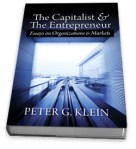 My new book, The Capitalist and the Entrepreneur: Essays on Organizations and Markets (Mises Institute, 2010), is now available. For a limited time, you can get it for just $15 — a bargain at half the price! Actually, the resource-constrained among you can read the Full Monty here, free of charge. A PDF version is also available. A promotional essay appears today on Mises.org.
The editorial and production staff did a terrific job, and I’m thrilled with the volume’s look and feel. The contents aren’t bad either!
Order two or more and I will personally send you a set of Ginsu knives.
Add to: Facebook | Digg | Del.icio.us | Stumbleupon | Reddit | Blinklist | Twitter | Technorati
Personnel Economics Survey
| Peter Klein |
Paul Oyer and Scott Schaefer provide a helpful overview:
Personnel Economics: Hiring and Incentives
Paul Oyer, Scott Schaefer
NBER Working Paper No. 15977We survey the Personnel Economics literature, focusing on how firms establish, maintain, and end employment relationships and on how firms provide incentives to employees. This literature has been very successful in generating models and empirical work about incentive systems. Some of the unanswered questions in this area — for example, the empirical relevance of the risk/incentive tradeoff and the question of whether CEO pay arrangements reflect competitive markets and efficient contracting — are likely to be very difficult to answer due to measurement problems. The literature has been less successful at explaining how firms can find the right employees in the first place. Economists understand the broad economic forces — matching with costly search and bilateral asymmetric information — that firms face in trying to hire. But the main models in this area treat firms as simple black-box production functions. Less work has been done to understand how different firms approach the hiring problem, what determines the firm-level heterogeneity in hiring strategies, and whether these patterns conform to theory. We survey some literature in this area and suggest areas for further research.
Add to: Facebook | Digg | Del.icio.us | Stumbleupon | Reddit | Blinklist | Twitter | Technorati
Transaction Costs and the Virtual Personal Assistant
| Peter Klein |
You can outsource grading, paralegal work, and other services, so why not personal assistance? Some credit cards now feature a concierge service that acts like a crowdsourced, virtual, personal assistant. By exploiting scale economies (a network of specialist assistants that can respond quickly and cheaply to specific client requests) and reducing excess capacity, such ser vices offer dramatically lowered production costs, compared to the conventional model of one dedicated assistant per client (or small group of clients). But the lack of bilateral commitment may make it difficult to encourage relationship-specific investments, so the transaction-cost effects are ambiguous. (Thanks to Chihmao for the pointer.)
If you want to discuss this further, have your people contact my people.
Add to: Facebook | Digg | Del.icio.us | Stumbleupon | Reddit | Blinklist | Twitter | Technorati
Readings for Hayek-Klein Day
| Peter Klein |
Here are some readings to help you celebrate tomorrow’s Hayek-Klein Day:

- Klein’s Biography of Hayek
- Hayek and Entrepreneurship
- Austrian Economics and Strategic Management
- The Use of Knowledge in Firms
- Austrian Economics and the Transaction Cost Approach
- Rothbard and Hayek
- Hayek versus Hayek
Add to: Facebook | Digg | Del.icio.us | Stumbleupon | Reddit | Blinklist | Twitter | Technorati
ICC Special Issue on Alfred Chandler
| Dick Langlois |
The most recent number of Industrial and Corporate Change is a special issue: Management Innovation-Essays in the Spirit of Alfred D. Chandler, Jr. Guest editors are Bill Lazonick and David Teece. Some interesting articles and definitely many interesting contributors. Yours truly was not involved — indeed, I didn’t learn about it until the table of contents appeared in my inbox. But I am cited in at least four of the papers. Indeed, the paper by Susan Helper and Mari Sako, both of whom I admire greatly, spends considerable time comparing my argument with Chandler’s. For the most part, I don’t disagree with their assessment except in respect of spin (more on which in a moment); but at one point they make an assertion that had me scratching my head.
Some argue that as a central tendency, the buffering and coordination functions of management are devolving to the mechanisms of modularity and the market — informational decomposition, flexibility, and risk spreading (Langlois, 2003: 377). In contrast, in Chandler’s world, “Increased specialization must, almost by definition, call for more carefully planned coordination if the volume of output demanded by the mass market is to be achieved” (Chandler, 1977: 490). The disagreement lies in different assumptions made. Langlois assumes that thickness of the market is exogenously given or that it is already established, while Chandler assumes that the mass market is something that has to be developed. Chandler’s view seems more correct here. (Helper and Sako 2010, p. 420)
Hello? One can argue that I have spent most of my career making precisely the point they attribute to Chandler: it’s the basis of the theory of dynamic transaction costs. Neither markets nor firms snap into existence but evolve slowly and — as I often quote Brian Loasby as pointing out — both require managerial coordination. (more…)
Miscellaneous Conference and Paper Links
| Peter Klein |
SSRN has a new Philosophy and Methodology of Economics working-paper series, sponsored by the International Network for Economic Method.
Here’s a CFP for a Special Issue of the E-conomics e-Journal on the Social Returns to Higher Education, R&D and Innovation.
You can watch a live stream of this weekend’s SEJ Special Issue Conference on Knowledge Spillovers & Strategic Entrepreneurship.
The registration and accommodations section of the ISNIE 2010 website is now open.
Add to: Facebook | Digg | Del.icio.us | Stumbleupon | Reddit | Blinklist | Twitter | Technorati
A Real Hostage Model
| Peter Klein |
Forget Williamson (1983). Check out Randall Morck and Fan Yang’s analysis of the 19th-century banks Shanxi, China. These banks featured a dual-class equity structure and, to mitigate agency problems created by entrenched insiders, not only gave insiders few voting rights, but also allowed outsiders to enslave insiders’ wives and children and hold their relatives as hostages. As Morck and Yang observe, with dry humor: “Modern civil libertarians might question some of these governance innovations, but others provide lessons to modern corporations, regulators, and lawmakers.”
Add to: Facebook | Digg | Del.icio.us | Stumbleupon | Reddit | Blinklist | Twitter | Technorati
Outsourcing TAs?
| Peter Klein |
An interesting make-or-buy decision for colleges and universities. Best line, from Roosevelt University B-school dean Terry Friel: “Faculty have this opinion that grading is their job, . . . but then they’ll turn right around and give papers to graduate teaching assistants. . . . What’s the difference in grading work online and grading it online from India?”
Add to: Facebook | Digg | Del.icio.us | Stumbleupon | Reddit | Blinklist | Twitter | Technorati
Posner on Institutions and Organizations, Round Two
| Peter Klein |
Remember the infamous Posner-Coase-Williamson exchange from JITE, 1993? Posner dismissed the New Institutional Economics as a derivative form of Posnerian law and economics, prompting unhappy replies from Coase and Williamson. Here’s Coase:
Posner [1993, 79] says that the first part of his paper describes “the conception of the field [the new institutional economics] held by Ronald Coase.” Reading this part of his paper recalled to my mind Horace Walpole’s opening remarks in his book on King Richard the Third: “So incompetent has the generality of historians been for the province that they have undertaken, that it is almost a question, whether, if the dead of past ages could revive, they would be able to reconnoitre the events of their own times, as transmitted to us by ignorance and misrepresentation” (Walpole [1768, 1]). I have only one foot through the door but should the final yank come before this piece is published, Horace Walpole’s words would apply exactly to Posner’s highly inaccurate account of my views.
Adds Williamson, wryly: “Richard Posner is a prolific writer and distinguished jurist. He is frequently asked to speak with wisdom and authority on many issues. Whether he hits the mark or misses varies with his depth of knowledge and understanding of those issues. . . . I content that Posner’s [1993] commentary mainly misses.”
Now Geoff Hodgson has produced a reboot: a long essay by Posner in the Journal of Institutional Economics titled “From the New Institutional Economics to Organization Economics: with Applications to Corporate Governance, Government Agencies, and Legal Institutions,” with replies from Jürgen Backhaus, Bruno Frey, Lin Ostrom, John Roberts, Tom Ulen, and several others (but not Coase or Williamson!). Posner focuses almost exclusively on the principal-agent problem, perhaps unaware that information, delegation, coordination, and adaptation are also important issues in organizational economics. His main conclusion seems to be that both private firms and public agencies are equally inefficient. Interesting reading, to be sure (and much better than Posner’s solipsistic essay on his conversion to Keynesianism, inexplicably published by the New Republic).
Agribusiness Economics and Management
| Peter Klein |
Congratulations to my colleague Mike Cook for his review paper on “Agribusiness Economics and Management” (with Rob King, Mike Boehlje, and Steve Sonka) in the new issue of the American Journal of Agricultural Economics. It’s a special issue commemorating the centennial of the American Agricultural Economics Association. Lots of good stuff here on the history and development of management theory and pedagogy, the evolution of the food sector, and the effects of the institutional environment on firm structure. Here’s the abstract:
Agribusiness scholarship emphasizes an integrated view of the food system that extends from research and input supply through production, processing, and distribution to retail outlets and the consumer. This article traces development of agribusiness scholarship over the past century by describing nine significant areas of contribution by our profession: (1) economics of cooperative marketing and management, (2) design and development of credit market institutions, (3) organizational design, (4) market structure and performance analysis, (5) supply chain management and design, (6) optimization of operational efficiency, (7) development of data and analysis for financial management, (8) strategic management, and (9) agribusiness education.
Mannepalooza at Austrian Scholars Conference
| Peter Klein |
Tune in here at 3:45 EST today for a live broadcast of the ASC session, “The Contributions of Henry G. Manne,” organized by yours truly. Panelists include me, Alexandre Padilla, Richard Vedder, Thomas DiLorenzo, and Henry Manne. And buy your copy of the Collected Works.
Update: audio files are now available: Klein, Padilla, Vedder, DiLorenzo, Manne.
Shareholder-Stakeholder Smackdown: Jensen, Freeman, Mintzberg, Khurana
| Peter Klein |
This looks like a fun event. Watch the Big Guys debate the future of the firm, management, and management education. It’s Fordham University’s W. Edwards Deming Memorial Conference, 11 May 2010 in New York City. Kudos to Mike Jensen for his willingness to walk into what will be, presumably, a line of fire. And remember, management theory is not to blame.
Org. Structure and Diversification
| Peter Klein |
The March 2010 issue of the Journal of Industrial Economics has just come out, and it features my paper with Marc Saidenberg, “Organizational Structure and the Diversification Discount: Evidence from Commercial Banking.” I’m quite happy with the paper, which went through many rounds of revision and consumed a great deal of time and energy. I blogged the details earlier. The published version is behind a firewall; if you can’t get through I’d be happy to mail you a copy.
Price Level Shocks, uhm, Screwed Up Relative Prices, and Organization
| Craig Pirrong |
Peter’s post on the relation between inflation, vertical integration, and markets brings a couple of other thoughts to mind.
First, and most importantly, the number and characteristics of markets are endogenous too, and respond to changes in the amount of uncertainty in the environment, including the amount of uncertainty resulting from monetary shocks that (in Sherwin Rosen’s unforgettable in-class phrase) “f*ck up relative prices.” In particular, the number and variety of futures markets depends on the amount of uncertainty. The big boom in the creation of futures markets in the 1970s corresponds with, and was arguably caused by, the coincident inflation of that period, and the associated volatility in relative prices.
Second, although Peter’s point, and previous research, focuses on the implications of inflation on organizational choices and market vs. firm choices, in the current environment it is worthwhile pondering the implications of deflation. Certainly we have more research on the effect of inflation on the variability of relative prices due to our more recent inflationary experiences, and this was a major source of concern about inflation among Austrians, but the current situation makes it worthwhile to consider the effects of deflation on the pricing system, and firms’ responses to that.
Perhaps an examination of Japanese experience since 1990 would be worth some in-depth analysis.
Personally I am torn as to whether inflation or deflation is the greater risk in the near to medium term. The huge monetary overhang in the US and around the world (resulting from quantitative easing and other extraordinary monetary policies), and the inability of the Fed to commit credibly to drain reserves from the system when money demand picks up make me believe that it will be hard to avoid a burst of inflation. But all current indicators point to flat or declining prices.
It is hard to see things ending in a Goldilocks moment — just right. Thus, it is likely that that there will be a shock to prices generally, arguably a large one, and that this will disrupt relative prices for a variety of reasons. (Including, notably, the very likely case where these price level shocks lead to government policy interventions that distort relative prices.)
Thus, Peter’s research program may be rejuvenated, courtesy of the Fed, ECB, the Chinese Central Bank, etc. It is indeed an ill wind that blows nobody any good.
Vertical Integration and the Informational Content of Prices
| Peter Klein |
Many years ago, when I was taking Williamson’s Economics of Institutions class at Berkeley and fishing around for dissertation topics, I had the idea to do some empirical work on the relationship between inflation and vertical integration or conglomerate diversification. The basic idea is that monetary expansion not only raises price levels, but also increases the dispersion of relative prices — introducing “noise” into the price mechanism — giving entrepreneurs an incentive to internalize transactions, on the margin, they would have otherwise conducted in the market. My interest was partly piqued by an off-hand remark by Dick in a review of Chandler’s Scale and Scope:
Things began to go wrong in the 1960s with the wave of conglomerate diversification, that is, with diversification by companies into areas wholly unrelated to their “core competence.” ITT was the paradigm of this phenomenon. Originally an international maker of telephone switching equipment, it bought, among other things, an insurance company and the maker of Hostess Twinkies. Chandler sees this as an inefficient practice, with many of the disbenefits of overextended British personal capitalism. There is no historical precedent for such unrelated diversification, he notes, except for German Konzerne during the hyperinflation of the 1920s. What is interesting — and what Chandler doesn’t mention — is that it is precisely inflation, in this case the Lyndon Johnson inflation of the 1960s, to which many have pointed as the cause of the wave of conglomerate mergers. The conglomerate is in effect an “internal capital market” that invests in a diversified portfolio of unrelated interests. But why? The stock market is much better at diversifying away risk than is such an arrangement, and it has many other advantages as well. In a time of inflation, the argument goes, price signals become distorted as managers find it difficult to disentangle changes in relative prices (that is, real prices) from changes in the price level. In such a world, the internal information and control within a conglomerate may have advantages that outweigh the disadvantage.
But, in any case, the trend in the less-inflationary 80s was the opposite one, the breaking apart of corporate holdings. . . .
The idea that conglomerate diversification, and “hierarchies” more generally, are responses to conditions in external markets has proven very useful in my own work; it also appears in Amar Bhidé’s neglected 1990 paper on diversification. Dick’s review cites a 1989 paper by Don Boudreaux and Bill Shughart linking US inflation rates and a measure of vertical integration but I couldn’t find such a relationship for diversification, and ended up going in a different direction. (more…)





 Organizations and Markets
Recent Comments