Posts filed under ‘Theory of the Firm’
Williamson Tribute in California Management Review
| Peter Klein |
Six new essays on Oliver Williamson by Haas School colleagues appear in the new issue of the California Management Review. They’re behind a subscription firewall, but just $6 a pop. Check ’em out:
Institutions, Politics, and Non-Market Strategy
de Figueiredo, Jr., Rui J.P.
Holdup: Implications for Investment and Organization
Hermalin, Benjamin E.
Antitrust Economics
Shapiro, Carl
Regulation: A Transaction Cost Perspective
Spiller, Pablo T.
Williamson’s Contribution and Its Relevance to 21st Century Society
Tadelis, Steven
Williamson’s Impact on the Theory and Practice of Management
Teece, David J.
Thanks to Mike Cook for the tip.
The Capitalist Kibbutz
| Peter Klein|
That’s how the Financial Times headlines this fascinating story about the transformation of many Israeli kibbutzim into partially privatized, profit-seeking, professionally managed entities that act in capital, product, and factor markets just like private firms. There are some similarities with the end of the socialist experiment in Russia: “‘The kibbutz was never isolated from society,’ says Shlomo Getz, the director of the Institute for Research of the Kibbutz at Haifa University. ‘There was a change in values in Israel, and a change in the standard of living. Many kibbutzniks now wanted to have the same things as their friends outside the kibbutz.”
The bottom line, from economist and former kibbutznik Omer Moav: “People respond to incentives. We are happy to work hard for our own quality of life, we like our independence. It is all about human nature — and a socialist system like the kibbutz does not fit human nature.” (Via BK Marcus.)
Rethinking the Diversification Discount
| Peter Klein |
A very good summary by Don Sull of recent literature on diversification. I like points #1 and #4 the best. He missed a few of the seminal papers (1, 2, 3) but nobody’s perfect. Note also that Sull is focusing on the corporate finance literature, which generally ignores inter-industry relatedness. In the strategic management literature, by contrast, relatedness (and its measurement) has been a central concern (see the references here).
Now That’s a Complete Contract!
| Peter Klein |
A major theme of the contracting literature in organizational economics is that formal contracts are inevitably incomplete, meaning that they do not specify actions and remedies for every possible set of circumstances. Given genuine uncertainty about the future, parties may decide that formal contracts to not adequately protect relationship-specific investments, providing an important rationale for vertical integration or another mechanism to protect quasi-rents (alliances, equity-sharing arrangements, reputation, and other “hybrids”).
A recent WSJ piece suggests that writing complete contracts may not be so hard after all:
Decked out in sequined black and gold dresses, Anne Harrison and the other women in her Bulgarian folk-singing group were lined up to try out for NBC’s “America’s Got Talent” TV show when they noticed peculiar wording in the release papers they were asked to sign.
Any of their actions that day last February, the contract said, could be “edited, in all media, throughout the universe, in perpetuity.”
My Mom says she once told me I was the best little boy in the world, to which I responded, “and all the planets too?” The WSJ gives several examples of similarly expansive coverage:
- The terms of use listed on Starwars.com, where people can post to message boards among other things, tell users that they give up the rights to any content submissions “throughout the universe and/or to incorporate it in other works in any form, media or technology now known or hereafter developed.”
- In a May 15, 2008, “expedition agreement” between JWM Productions LLC, a film-production company, and Odyssey Marine Exploration Inc., a shipwreck-exploration outfit, JWM seeks the rights to footage from an Odyssey expedition. The contract covers rights “in any media, whether now known or hereafter devised, or in any form whether now known or hereafter devised, an unlimited number of times throughout the universe and forever, including, but not limited to, interactive television, CD-ROMs, computer services and the Internet.”
And my personal favorite:
A 189-word sentence in a September agreement between Denver-based Spicy Pickle Franchising Inc. and investment bank Midtown Partners & Co. — which has helped raise capital for the sandwich and pickle shops dotted across the region — unconditionally releases Spicy Pickle from all claims “from the beginning of time” until the date of the agreement.
Says Spicy Pickle’s Marc Geman, “the length of the paragraph is only limited by the creativity of the attorney.”
ISNIE 2010 Call for Papers
| Peter Klein |
The Call for Papers is out for the International Society for New Institutional Economics’s 2010 meeting, 17-19 June in Stirling, Scotland. Proposals are due 1 March. President-Elect Frank Stephen is putting together an impressive program with keynotes from Bruno Frey and two longtime ISNIE members you may have heard of: Elinor Ostrom and Oliver Williamson. Don’t miss it!
CFP: “Understanding Firm Growth”
| Peter Klein |
The Ratio Institute invites paper proposals from young scholars (sorry, O&M bloggers!) in economics, economic history, entrepreneurship, management, sociology, statistics, psychology, and related disciplines for a workshop on firm growth in Stockholm, 12-14 August 2010. David Audretsch and Alex Coad are keynoting. Suggested topics include the role of high-growth firms, determinants of the growth of firms, growth ambitions and attitudes towards growth, firm growth and the characteristics of the entrepreneur, the persistence of firm growth, barriers to growth, post-entry performance, firm growth in a historical perspective, and innovation and firm growth. Details here.
The Virtual Firm
| Peter Klein |
If the proprietor has been to business school, it can never be smaller than two persons:

Bonus material, via Craig Newmark: the Boston Globe ponders “The End of the Office.” But it won’t happen, IMHO.
Do Top Scholars Make the Best University Leaders?
| Peter Klein |
Yes, says Amanda Goodall here and here. Here’s a summary and here’s some commentary. Her argument is based on inside knowledge, the ability to set appropriate standards, signaling, and legitimacy. Signaling strikes me as the most plausible (non-academic administrators may not have knowledge or legitimacy but they can hire subordinates who do). I haven’t studied the work carefully, however. Kudos to Goodall for tackling an important subject.
Her Vox article singles out economist-administrators for special mention. They seem to be doing quite well, Larry Summers notwithstanding.
A New Hawthorne Study
| Peter Klein |
Tanjim Hossain and John List have done a Hawthorne-type study on a Chinese high-tech manufacturing company. The paper, “The Behavioralist Visits the Factory: Increasing Productivity Using Simple Framing Manipulations,” is unfortunately gated at NBER. I’m surprised it’s taken this long for someone to take advantage of the current craze for field experiments to do this kind of study. (I wonder if IRB approval is easier when the test subjects are in China?) Check out the abstract:
Recent discoveries in behavioral economics have led to important new insights concerning what can happen in markets. Such gains in knowledge have come primarily via laboratory experiments — a missing piece of the puzzle in many cases is parallel evidence drawn from naturally-occurring field counterparts. We provide a small movement in this direction by taking advantage of a unique opportunity to work with a Chinese high-tech manufacturing facility. Our study revolves around using insights gained from one of the most influential lines of behavioral research — framing manipulations — in an attempt to increase worker productivity in the facility. Using a natural field experiment, we report several insights. For example, conditional incentives framed as both “losses” and “gains” increase productivity for both individuals and teams. In addition, teams more acutely respond to bonuses posed as losses than as comparable bonuses posed as gains. The magnitude of the effect is roughly 1%: that is, total team productivity is enhanced by 1% purely due to the framing manipulation. Importantly, we find that neither the framing nor the incentive effect lose their importance over time; rather the effects are observed over the entire sample period. Moreover, we learn that worker reputation and conditionality of the bonus contract are substitutes for sustenance of incentive effects in the long-run production function.
See also List’s paper with Levitt on the original Hawthorne experiments.
Happy Birthday, Ronald!
 | Peter Klein |
Happy Birthday to Ronald Coase, 99 years young today. Live long and prosper!
Favorite under-appreciated Coase essay of the day: “Business Organization and the Accountant.”
Update: Oops, Mike Sykuta tells me that the birthday is actually tomorrow, 29 December. (I blame the Coase Institute, which sent out a Facebook message on 28 December saying “Congratulations to Ronald Coase on his 99th birthday today, December 29.” I didn’t catch the goof.)
Update II: A friend asks why new institutional economists live so long. I suggested a keen appreciation of comparative institutional analysis, reflected in a version of the old adage, “Getting old isn’t so bad, once you consider the feasible alternative.”
Entrepreneurship and Action
| Peter Klein |
A few entrepreneurship scholars see action under uncertainty, rather than perception of opportunity, as the essence of the entrepreneurial function. Really, really eminent scholars. Anyway, here’s a little etymological tidbit along these lines from Jesús Huerta de Soto’s book The Austrian School: Market Order and Entrepreneurial Creativity:
Indeed both the Spanish word empresa and the French and English word entrepreneur derive etymologically from the Latin verb in prehendo-endi-ensum, which means “to discover, to see, to perceive, to realize, to capture”; and the Latin term in prehensa clearly implies action and means “to take, to seize.” In short, empresa is synonymous with action. In France, the word entrepreneur has long conveyed this idea — since the High Middle Ages, in fact when it was designated to those in charge of performing important and generally war related deeds or to those entrusted with executing the large cathedral building projects.
Thanks to Dan D’Amico for calling my attention to this passage.
PS: On the more general claim that entrepreneurship should be treated as an abstract function, rather than an employment category, I call to the stand Edith Penrose, who writes in Theory of the Growth of the Firm (chapter 3, footnote 1):
The term “entrepreneur” throughout this study is used in a functional sense to refer to individuals or groups within the firm providing entrepreneurial services, whatever their position or occupational classification may be.
You go, girl!
Disney Organizational Chart, circa 1943
| Peter Klein |
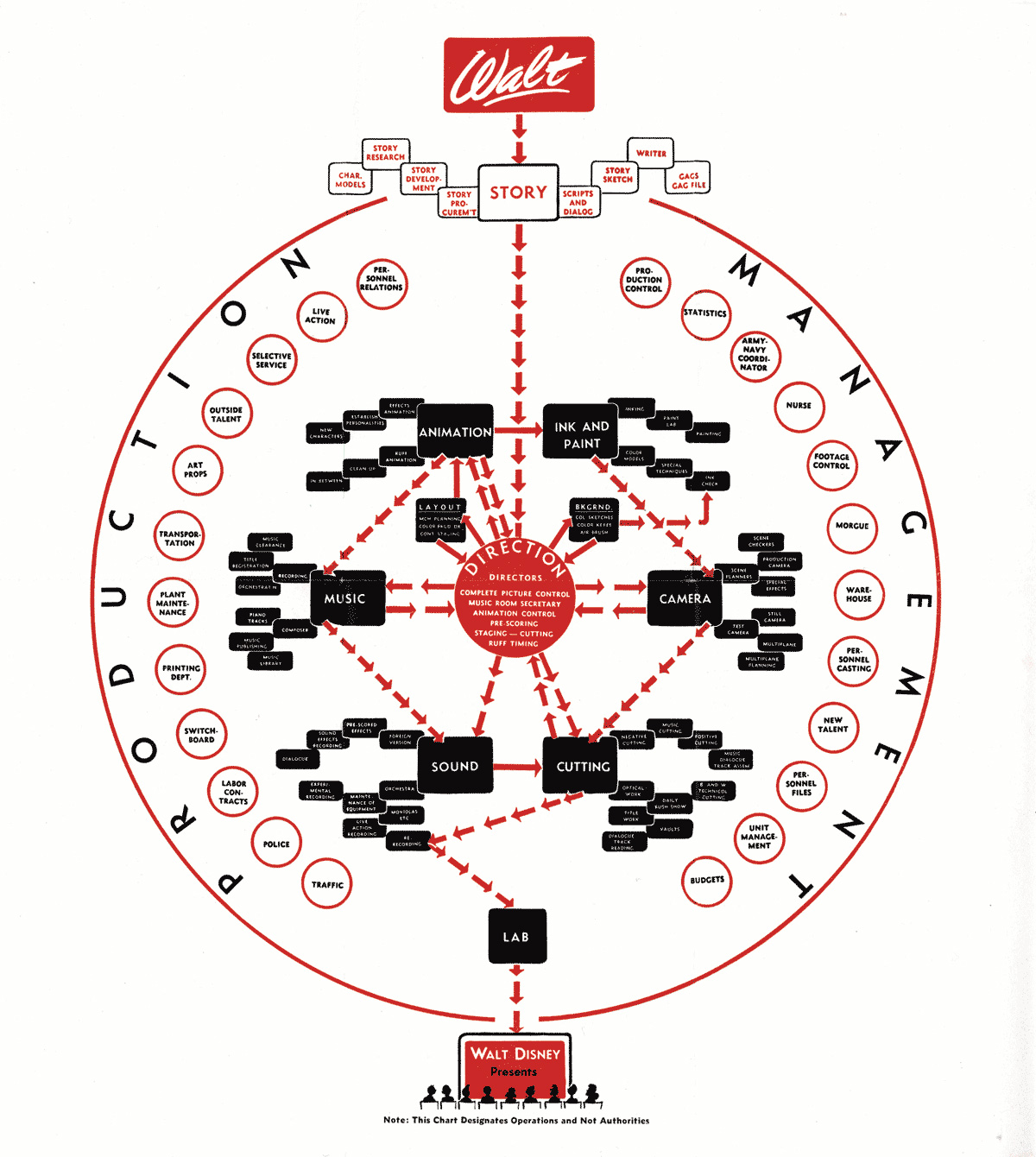
This week’s passing of Roy Disney has brought forth some interesting discussion of the firm founded by his uncle Walt and father Roy. Check out this Disney organizational chart from 1943 (click to enlarge), courtesy of design site @issue. Unlike the typical corporate hierarchy, writes Delphine Hirasuna, Disney’s “is based on process, from the story idea through direction to the final release of the film. All of the staff positions are in the service of supporting this work flow.” (From Cliff Kuang via WeLoveDataVis.)
CFP: “Contracts, Procurement, and Public-Private Arrangements”
| Peter Klein |
It’s 14-15 June 2010 in Paris. Submissions are due 15 February. Stéphane Saussier is organizing, so you know it will be good. From the CFP:
This conference focuses on the recent developments in contract theories. Papers are invited on all topics of contract theories including:
- relational contracting,
- transaction costs,
- renegotiations,
- incentives,
- attribution mechanisms,
- incomplete contracting
- contract design, etc.
Papers presented may be theoretical or applied. A special attention will be given to proposals addressing issues related to procurement and public-private arrangements.
“This Paper Fills a Much-Needed Gap in the Literature”: Today’s Edition
| Peter Klein |
I was thumbing through the MDE issue containing Lasse and Nicolai’s paper when this sentence caught my eye: “Despite the widespread use of the production frontier approach to assess the efficiency of firms, there are no studies on ski lift operators.”
OK, I actually like the paper, “Are Multi-Resort Ski Conglomerates More Efficient?” by Martin Falk. It shows that resorts affiliated with a particular operator, Intrawest, have higher efficiency scores than independent resorts (and those affiliated with other ski conglomerates). There isn’t much theory, and I worry about endogeneity and unobserved heterogeneity — the major themes in recent empirical work on diversification — but I certainly agree that parental affiliation is an important, and often overlooked, issue. (Indeed, one of my favorite Brad De Long papers, from the old days before he became a full-time polemicist, deals with this problem.)
Maybe I’m just jealous that I didn’t think of this particular application when doing my own research on conglomerates. Oh, the travel grants I could have applied for!
Williamson Nobel Lecture Is Streaming Now
| Peter Klein |
Watch it here.

Money quotes so far:
- After questioning the design of the Department of Homeland Security: “The US has a Council of Economic Advisers; I look forward to the day when there’s also a Council of Organizational Advisers” [paraphrase].
- “That brings us to the ‘remediableness’ criterion. That word doesn’t exactly roll of the tongue. But my students have learned to say it after much repetition.”
Update: The stream is over, I’ll post a link to the archived file when I find it. Note that the ceremony is December 10, to be streamed here.
Update II: Via the ever-reliable Per Bylund, the archive link is here.
Becker and Posner on Williamson and Organizational Economics
| Peter Klein |
Ruminations on the field of organizational economics from Becker and Posner. Both are inspired by Williamson’s Nobel but neither discusses his contributions very directly. Posner’s comment, the longer of the two, describes some of his own work (with Luis Garicano) on public organizations.
PS: I’ve been looking for some time for an electronic copy of the 1993 Journal of Institutional and Theoretical Economics exchange between Posner, Coase, and Williamson. If anyone has it, can you email me a copy?
Internal and External Corporate Governance
| Peter Klein |
Most of the corporate governance literature focuses on external mechanisms for limiting managerial discretion: competition in product and factor markets; discipline from banks, institutional investors, and other large capital suppliers; and, of course, the market for corporate control. Firms have access to internal control mechanisms as well — performance-based pay, internal audits, a strong Board, competition among the top-management team, adoption of the M-form structure, and so on — but these are usually considered weaker, less effective instruments.
Viral Acharya, Stewart Myers, and Raghu Rajan have a new theory paper, “The Internal Governance of Firms,” on internal control mechanisms, focusing on dividend policy as a means of satisfying both internal and external constituents. NBER version here, ungated version here, older SSRN version here. Abstract:
We develop a model of internal governance where the self-serving actions of top management are limited by the potential reaction of subordinates. Internal governance can mitigate agency problems and ensure that firms have substantial value, even with little or no external governance by investors. Internal governance works best when both top management and subordinates are important in generating cash flow. External governance, even if crude and uninformed, can complement internal governance and improve efficiency. This leads to a theory of investment and dividend policy, where dividends are paid by self-interested CEOs to maintain a balance between internal and external control. Our paper can explain why firms with limited external oversight, and firms in countries with poor external governance, can have substantial value.
The WSJ on Vertical Integration
| Peter Klein |
It’s not as bad as this 2006 piece from Slate, but Monday’s WSJ front-pager, “Companies More Prone to Go ‘Vertical,'” is underwhelming at best. It shares a few interesting anecdotes about recent vertical mergers, but falls flat on two major grounds. First, like the Slate piece, it assumes that the advances in IT over the last few decades led to some sort of tectonic shift away from vertical integration, against which firms are now reacting by “rediscovering” the benefits of vertical coordination. Actually there’s little evidence for such a shift. Second, and more important, the article doesn’t bother to mention any theories about what vertical integration is and does. There are vague references to commodity-price volatility and the need to “control” the supply chain, but no recognition that risk-management and control over inputs can be achieved through contract as well as integration. Given that one of this year’s Nobel Laureates won the prize for his work on precisely this problem, you’d think some reference to transaction costs might be appropriate. Old Media, R.I.P.
User Innovation and Collaborative Innovation
| Dick Langlois |
Two of my favorite scholars, Carliss Baldwin and Eric von Hippel, have bridged the Charles to team up on a joint manifesto pushing their related views on innovation. The paper is subtitled (or is it supertitled?) “Modeling a Paradigm Shift.” Here is the abstract.
In this paper we assess the economic viability of innovation by producers relative to two increasingly important alternative models: Innovations by single user individuals or firms, and open collaborative innovation projects. We analyze the design costs and architectures and communication costs associated with each model. We conclude that innovation by individual users and also open collaborative innovation increasingly compete with — and may displace — producer innovation in many parts of the economy. We argue that a transition from producer innovation to open single user and open collaborative innovation is desirable in terms of social welfare, and so worthy of support by policymakers.
Carliss has always been more willing than I am to make a normative case for modularity, which is the idea underlying the collaborative model. But she does have some analytical arguments to back that up. The “worthy of support by policymakers” part actually turns out to be a healthy argument against present-day political forces in the direction of stronger intellectual property rights. As this blog has noted in the past, these political forces are moving opposite to increased patent skepticism among scholars.
The Lazy Manager Theory
| Peter Klein |
Good ideas from John Wilkins, who earned a PhD in (I think) evolutionary biology while working as a full-time manager (via Randy). Sample elements of the Lazy Manager Theory:
- Never do any piece of paperwork when the person who asked for it isn’t there and holding it when they make the request. If they don’t care enough to come see you, they probably don’t need it done. Also, you put faces to names and develop a good personal relationship with those who come to see you, so it’s win-win.
- If any piece of paper falls off your desk for any reason, throw it away. This is God’s way of telling you it is unimportant.
- Always sit on the left side of the table, at the far end from the secretary if you aren’t that person. This way when tasks are being handed out, you are less likely to be volunteered, as you are not in the immediate line of sight of either the chair or the secretary.
If you prefer meatier fare, try this paper from Philippe Aghion, John Van Reenen, and Luigi Zingales, “Innovation and Institutional Ownership,” which examines a version of the lazy-manager hypothesis:
We find that institutional ownership in publicly traded companies is associated with more innovation (measured by cite-weighted patents). To explore the mechanism through which this link arises, we build a model that nests the lazy-manager hypothesis with career-concerns, where institutional owners increase managerial incentives to innovate by reducing the career risk of risky projects. The data supports the career concerns model. First, whereas the lazy manager hypothesis predicts a substitution effect between institutional ownership and product market competition (and managerial entrenchment generally), the career-concern model allows for complementarity. Empirically, we reject substitution effects. Second, CEOs are less likely to be fired in the face of profit downturns when institutional ownership is higher. Finally, using instrumental variables, policy changes and disaggregating by type of owner we find that the effect of institutions on innovation does not appear to be due to endogenous selection.





Recent Comments