Posts filed under ‘Theory of the Firm’
Best Paper Excerpt I Read Today
| Peter Klein |
What I call here an “orthodox” or mainstream Austrian theory of the firm is an attempt to reshape a Coasian notion of the firm as a centrally planned hierarchy, by merging it with general Austrian theory of the market process and entrepreneurship. The principal Austrians of the present (Klein and Foss, 2005, Foss 1994, Langlois and Foss, 1997) developed a theory of the firm by trying to synthesize this Coasian notion of the firm as a hierarchical entity dominated by commands and orders, with a distinct Misesian theory of entrepreneurship and monetary calculation as preconditions of rational economic planning. This approach is entirely rejected in this paper.
Source. I always thought of myself as a Young Turk, but I guess I’m now Old Guard.
The (Very) Early Adoption of Modern HRM Practices
| Peter Klein |
Bruce Kaufman’s book Hired Hands or Human Resources? Case Studies of HRM Programs and Practices in Early American Industry (Cornell U. P., 2010) shows that US firms started adopting “modern” HRM practices around World War I, not during the New Deal, and they did so primarily to increase productivity, not in response to union or government pressure. Writes reviewer Chad Pearson:
Kaufman illustrates the ways in which several companies created professional human resource management (HRM) models after World War I. This is the most valuable part of the book principally because he used the records of the Industrial Relations Councilors (IRC), a consulting firm that began assisting employers in the 1910s. The IRC offered consulting services, provided research, and ran courses on industrial relations topics throughout the nation. Kaufman, the first scholar to examine these records, believes that “no other [industrial relations consulting firm] before World War II had IRC’s reach and influence” (p. 108). . . .
In most cases, these firms, in consultation with the IRC, began to, in Kaufman’s words, treat labor not as “a short-term commodity,” as was common in previous decades, but rather as “a longer-term human capital asset (the ‘human resource’ approach)” (p. 219). Why? Pressure from unions and the law were factors, but “they were less than half the story in the time period we are examining” (p. 228). In his view, employers’ desires to improve “management and productivity” better explain why companies improved workplace conditions (p. 227).
Labor historians and specialists in business regulation used to focus on the Progressive Era as a watershed period — e.g., Wiebe (1962), Weinstein (1981), and of course Kolko (1977) — but interest seems to have waned.
The Ownership of the Firm under a Property Rights Approach
| Dick Langlois |
That’s the title of a new working paper by my Ph.D. student Leshui He. Here’s the abstract:
The boundaries of the firm and the ownership of the firm have been two of the main themes of the economics of organization over the past several decades. In this paper, I develop a general multi-party framework that integrates the ownership of the firm into the property-rights approach to the firm. I consider the ownership of the firm as the ownership of the rights to terminate cooperation with any party while maintaining a contractual or employment relation with all the other related parties of the firm. The model in this paper allows for the separation of the ownership of the firm from the ownership of the alienable assets that partly constitute it. Such a general multi-party setup may provide new tools for the study of the problem of the firm’s boundaries as well as inspiration for further applications of the theory of property rights.
This will be Leshui’s job market paper. Comments (and job offers) welcome.
Misbehavioral Antitrust
| Peter Klein |
I suggested earlier that behavioral economics could use a dose of comparative institutional analysis. The New Paternalists are very worried about various biases and forms of “irrationality” on the part of consumers, managers, entrepreneurs, investors, etc. but have little or nothing to say about the rationality of regulators, legislators, judges, and other non-market actors. Josh Wright and Judd Stone offer a parallel critique of behavioral economics applied to antitrust law: the behavioralists focus on presumed bias and irrationality on the part of incumbents, while largely ignoring the cognitive attributes of rivals and potential entrants. Josh and Judd propose an “irrelevance theorem”: “If one assumes a given behavioral bias applies to all firms — both incumbents and entrants — behavioral antitrust policy implications do not differ from those generated by the rational choice models of mainstream antitrust analysis.”
Addendum: Steve Horwitz made the comparative institutional argument in an earlier post that I unfortunately missed.
Tilburg Conference on Private Ordering
| Scott Masten |
O&M readers might be interested in a conference held this week (Sept. 30 – Oct. 1) at the Tilburg Law and Economics Center on the topic “Economic Governance and Competition: The Pros and Cons of Private Ordering in the Shadow of the Law.” The conference was organized by Jens Prüfer and featured keynote presentations by Lisa Bernstein, Avinash Dixit, Robert Gibbons, and Bentley MacLeod. Many interesting papers, several of the authors of which will be familiar to the O&M/ISNIE crowd. The full program, including downloadable papers, can be found here. (Would have liked to attended but classes interfered.)
Elgar Companion to TCE
 | Peter Klein |
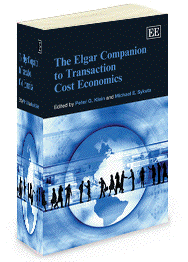
The Elgar Companion to Transaction Cost Economics, edited by Mike Sykuta and me, has just been published. Twenty-nine chapters cover the basic structure of TCE, its precursors and influences, fundamental concepts, applications and evidence, along with alternatives and critiques. Oliver Williamson was kind enough to contribute an introduction and overview. Co-blogger Foss is in there as well.
O&M readers can get it here 10 percent off the list price! (Actually, anybody can get the deal.) Mike beat me to the punch with an announcement and description, so I’ll just add that we’re really pleased with the final product and grateful to all the distinguished contributors and the production staff.
Here are previous O&M posts on transaction cost economics.
Introducing Guest Blogger Scott Masten
| Peter Klein |
It’s a real pleasure to introduce Scott Masten as our newest guest blogger. Scott is Professor of Business Economics and Public Policy at the University of Michigan’s Ross School of Business and a leading figure in the transaction cost approach. Trained by Oliver Williamson at Penn, Scott was one of the first (along with David Teece and a few others) to do systematic empirical work on alternative institutions of governance. Scott’s 1984 paper on procurement in aerospace, his 1985 paper (with Keith Crocker) on characteristics of natural gas contracts, and his 1991 paper (with James Meehan and Ted Snyder) on the costs of internal organization are classics in the transaction cost literature. Scott has also made important contributions to law and economics, antitrust, contract theory, and many other areas. He’s a past president of ISNIE, co-editor of JEMS, and, as I learned a few years ago at a conference for Williamson’s 70th birthday, a wickedly funny after-dinner speaker.
We’re delighted to have Scott on the team and look forward to his insights. Welcome, Scott!
24 September 2010 at 11:40 pm Peter G. Klein Leave a comment
Two Economics Papers About Culture
| Peter Klein |
The New Institutional Economics focuses mainly on formal rules, both “macro” (constitutions, legal systems, written languages) and “micro” (firms, contracts, other formal agreements). But there are many studies of informal or semi-formal constraints — norms, conventions, religion, belief systems, and other aspects of culture, broadly conceived. Given their commitment to methodological individualism, New Institutional Economists tend to explain the emergence and stability of these phenomena as the consequences — typically unintended — of purposeful individual choices (which distinguishes us from our colleagues on the other side of the aisle). (Culture is important within organizations, as well as between them, though attempts to explain organizational culture in this manner have been less successful.)
Does Culture Matter?
Raquel FernándezThis paper reviews the literature on culture and economics, focusing primarily on the epidemiological approach. The epidemiological approach studies the variation in outcomes across different immigrant groups residing in the same country. Immigrants presumably differ in their cultures but share a common institutional and economic environment. This allows one to separate the effect of culture from the original economic and institutional environment. This approach has been used to study a variety of issues, including female labor force participaiton, fertility, labor market regulation, redistribution, growth, and financial development among others.
Do Social Connections Reduce Moral Hazard? Evidence from the New York City Taxi Industry
C. Kirabo Jackson, Henry S. SchneiderThis study investigates the role of social networks in aligning the incentives of economic agents in settings with incomplete contracts. We study the New York City taxi industry where taxis are often leased and lessee-drivers have worse driving outcomes than owner-drivers as a result of a moral hazard associated with incomplete leasing contracts. Using instrumental variables and fixed-effects analyses, we find that: (1) drivers leasing from members of their country-of-birth community exhibit significantly reduced effects of moral hazard; (2) network effects appear to operate primarily via social sanctions; and (3) network benefits can help to explain the organization of the industry in terms of which drivers and owners form business relationships.
The Corporate Hierarchy Dies, Again
| Peter Klein |
Ronald Coase described his 1937 paper on the firm as “much cited, but little used.” He was referring to the academic literature, but these days it seems to apply to the popular press as well. Almost every week brings a new article on the death of the corporate hierarchy: you know, firms only exist to deal with transaction costs, and the Internet has reduced them to almost zero, so who needs firms? This argument shows up again and again. But it’s wrong. Of course there are transaction costs between firms (search, bargaining, enforcement). But there are also transaction costs inside firms (agency and information costs, the Misesian calculation problem). The firm straddles these margins. Both sets of transaction costs matter, and both can be reduced through technological change. Coase was not as clear on this point as he could have been, but Williamson has been explaining it for decades, in terms of “comparative contracting costs.” You have to compare both sets of costs, not just look at one. Why is it so hard to see?
Saturday’s WSJ gives us the latest version of the bogus argument, this time from Alan Murray. Same old story: Internet, transaction costs, Tapscott and Williams, wikipedia, yada yada yada. “Mr. Coase received his Nobel Prize in 1991 — the very dawn of the Internet age. Since then, the ability of human beings on different continents and with vastly different skills and interests to work together and coordinate complex tasks has taken quantum leaps. Complicated enterprises, like maintaining Wikipedia or building a Linux operating system, now can be accomplished with little or no corporate management structure at all.” Yawn. “[T]he trends here are big and undeniable. Change is rapidly accelerating. Transaction costs are rapidly diminishing. And as a result, everything we learned in the last century about managing large corporations is in need of a serious rethink.” Zzzzzzzzzzzzzzz. Mr. Murray, please read The Victorian Internet three times fast and have a report on my desk first thing in the morning. “The new model will have to be more like the marketplace, and less like corporations of the past. It will need to be flexible, agile, able to quickly adjust to market developments, and ruthless in reallocating resources to new opportunities.” Right, no corporations of the past ever tried to do this.
Add to: Facebook | Digg | Del.icio.us | Stumbleupon | Reddit | Blinklist | Twitter | Technorati
O&M in Lund
| Peter Klein |
 Nicolai and I, along with Jay Barney and John Matthews, are headlining the 2010 Holger Crafoord Memorial Symposium on “Strategy and Entrepreneurship,” 7 September 2010 at the Lund School of Economics and Management. The symposium is free but registration is required; details at the link above. Lund is a lovely university town, a short train ride (via the Øresund Bridge) from Copenhagen and hence easy to reach. A good time will be had by all.
Add to: Facebook | Digg | Del.icio.us | Stumbleupon | Reddit | Blinklist | Twitter | Technorati
Lachmann on Capital Heterogeneity
| Peter Klein |
We have written often on the role of capital heterogeneity in an entrepreneurial theory of the firm. “We are living in a world of unexpected change,” wrote Ludwig Lachmann in 1956; “hence capital combinations . . . will be ever changing, will be dissolved and reformed. In this activity, we find the real function of the entrepreneur.” Of course, the concept of heterogeneous resources is fundamental to transaction cost and resource-based views of the firm. It is mostly ignored by mainstream economists, however — macroeconomists in particular, as evidenced by the Old School Keynesianism that drives bailout and stimulus policy.
Here is Richard Ebeling with a fine overview of Lachmann’s capital theory, in contrast to Keynes’s superficial treatment:
A crucial element in Lachmann’s view of capital . . . is that the relationships between and among capital goods are those of substitutes and complements.
The Keynesian fallacy, Lachmann implies, is that Keynes tended to view and consider the capital stock has a more or less homogeneous aggregate under which all capital goods might be considered as interchangeable substitutes. Thus, any increase in capital investment lowers the “marginal efficiency of capital” (Keynes’ term) of every other unit of capital, since every unit of capital is a substitute with all other capital. . . .
Thus, if monetary manipulation brings about an increase in money and credit, and a resulting distortion of the rates of interest, and if this generates a tendency for misguided capital and related investments, and as a consequences capital goods and various types of labor are drawn into particular sectors of the economy and “stages” of the time structure of production, then . . .
You know the rest. And the coda too:
Government interventions and “stimulus” gimmicks merely serve to delay the adjustments and further distort an already distorted market. It is an attempt to maintain capital and labor complementary production and investment structures that are unsustainable in many of the patterns generated during the boom phase of the business cycle.
Add to: Facebook | Digg | Del.icio.us | Stumbleupon | Reddit | Blinklist | Twitter | Technorati
Does Knowledge Management Improve Performance?
| Peter Klein |
Yes, says Peter Cappelli:
The extensive literature on knowledge management spans several fields, but there are remarkably few studies that address the basic question as to whether knowledge management practices improve organizational performance. I examine that question using a national probability sample of establishments, clear measures of IT-driven knowledge management practices, and an experimental design that offers a unique approach for addressing concerns about endogeneity and omitted variables. The results indicate that the use of company intranets, data warehousing practices, performance support systems, and employee competency databases have significant and meaningful effects on a range of relevant business outcomes.
Cappelli relies on a national (US), establishment-level survey of knowledge-management practices to construct a panel in which (according to the practioner literature) none of the knowledge-management practices under consideration existed at the start of the sample period. Check it out.
Add to: Facebook | Digg | Del.icio.us | Stumbleupon | Reddit | Blinklist | Twitter | Technorati
Performance Evaluation Links
| Peter Klein |
Performance evaluation is a favorite topic here at O&M; readers may enjoy these miscellaneous items on measurement:
- “Is Impact Measurement a Dead End?” by Alanna Shaikh, guest blogging at AidWatch.
- Moneyball’s Michael Lewis on basketball player statistics (HT: PB).
- The Urban Institute’s Outcome Indicators Project for nonprofits.
- Relevant Demotivators: Flattery, Ineptitude, and Mediocrity.

Add to: Facebook | Digg | Del.icio.us | Stumbleupon | Reddit | Blinklist | Twitter | Technorati
The Organizational Economics of the BP Oil Spill
 | Peter Klein |
Now that passions are cooling regarding the BP disaster, it’s time to bring organizational issues into the discussion.
1. Everyone knows about the liability caps and the role they may have played in encouraging moral hazard. Just as bank deposits are guaranteed by government deposit insurance, and large banks themselves are probably Too Big to Fail, liability for property damage from oil spills off US waters is limited to $75 million (plus cleanup costs), based on a 1990 law passed after the Exxon Valdiz spill. This presumably mitigates drillers’ incentives to manage environmental risk. Indeed, oil companies enjoy a very cozy relationship with their ostensible guardians; as the NY Times noted, “[d]ecades of law and custom have joined government and the oil industry in the pursuit of petroleum and profit.” The federal agency that oversees drilling, the Minerals Management Service, rakes $13 billion a year in fees in what amounts to a public-private partnership. And does anyone really think the British government would “stand idly by” if BP’s status as an ongoing concern were threatened by criminal or civil penalties?
2. As Bill Shughart points out, BP did not own the Deepwater Horizon platform, but leased it from a company called Transocean. To Bill this suggests “a classic principal-agent problem in which the duties and responsibilities of lessor and lessee undoubtedly were not spelled out fully, especially with respect to maintenance and testing of the rig’s blowout preventer as well as to the advisability of installing a second ‘blind sheer ram,’ which may have been able to plug the well after the first (and only one then in service) failed to do so.” Would BP have paid more attention to safety if it owned, rather than leased, the platform? (more…)
Miscellaneous Organizational Links
| Peter Klein |
- The much-anticipated KKR IPO turned out to be a snoozer. But what the heck is a publicly traded private-equity firm anyway?
- Is the flattening hierarchy an illusion, driven by job-title inflation?
- How call centers use behavioral economics.
- Belén Villalonga’s new paper on ownership concentration and internal-capital-market efficiency — highly recommended.
Add to: Facebook | Digg | Del.icio.us | Stumbleupon | Reddit | Blinklist | Twitter | Technorati
Tesla (the Car)
| Dick Langlois |
 Speaking of Tesla: as I was waiting to cross Page Mill Road in Palo Alto the other day, I saw a real live Tesla drive by — the car, not the long-dead inventor. There are several dealerships along El Camino.
In their recent comment, Mari Sako and Susan Helper suggested that electric vehicles might be an example in which, because of the systemic nature of innovation, we might see considerable vertical integration à la Chandler. They talked about the complementary network of charging stations, etc. But it seems to me that what vertical integration the electric vehicle will bring about is more likely to be in the design and production of the car itself. For example, the Tesla website notes that the “Roadster is controlled by state-of-the-art vehicle software. Rooted in Silicon Valley tradition, the code is developed in-house with an intense focus on agile and constant innovation.” Presumably they mean that the code itself, not the vertical integration, is rooted in Silicon Valley tradition.
Apparently, Tesla (along with Toyota) is going to reopen the famed NUMMI plant in Fremont to make its new passenger-car model.
Add to: Facebook | Digg | Del.icio.us | Stumbleupon | Reddit | Blinklist | Twitter | Technorati
Stanford Conference on the Asian Firm
| Dick Langlois |
I’m in Palo Alto, having just participated in an extremely interesting conference at Stanford called “The Future of Industry and Innovation in Asia: Firms, Alliances and Networks.” (Papers are not on the website, but you can email the authors.) The conference was organized by Mark Fruin and Raffiq Dossani, and featured people like Martin Kenney, Masao Nakamura, Tim Sturgeon, and Eleanor Westney.
Add to: Facebook | Digg | Del.icio.us | Stumbleupon | Reddit | Blinklist | Twitter | Technorati
More on Managerial Coordination and the Vanishing Hand
| Dick Langlois |
Many many thanks to Mari Sako and Susan Helper for taking the time to comment on my post about their paper in ICC. To give the discussion more visibility, I am elevating my response to a new post.
My Vanishing Hand argument is an attempt to explain theoretically the demise of the large multi-unit Chandlerian enterprise, the essence of which was managerial coordination across vertically integrated stages of production. That is to say, my argument was about vertical disintegration. To assert that a more-disintegrated system still uses managerial coordination across firm boundaries is not to resurrect Chandler’s vision; it is to back away from Chandler’s vision. (I document Chandler’s vision, and its intellectual roots, with more care in the book than in the original “Vanishing Hand” paper.) My argument is fundamentally about vertical integration, and I have no problem with the idea that managerial coordination is often exercised across the boundaries of firms. I’ll return to this point in a second.
Sako and Helper argue that, if minimum efficient scale is falling, the size of firms should be falling. And Giovanni Dosi and his coauthors claim that firm size isn’t falling. Well, first of all, MES determines plant size not firm size. It sets a lower bound on firm size; it doesn’t guarantee a smaller firm size. But the real point here is: what does “size” mean? As I pointed out in my response to Dosi et al., their evidence is at best about firm size in the sense of price theory: number of widgets per unit time. My argument is about firm size in the sense of Coase: number of activities undertaken within the boundaries of the firm. Vertical disintegration is perfectly consistent with larger firm size in the sense of price theory; in fact, we might expect it. (more…)
Isomorphism in Higher Education
| Peter Klein |
 Amitai Etzioni is upset that new firms are entering the higher-education market and offering — gasp! — a differentiated product. Worst of all, they operate on a for-profit basis! (“For-profit,” as left-leaning intellectuals know, is synonymous for “evil.”) Consider:
The education students receive at for-profit colleges bears little resemblance to the kind they would get at a true liberal arts college. Neither does it resemble the collegial image the for-profit colleges love to project. Professors at these schools often work on short contracts. There is no tenure. The executives make staggering salaries. Most students are taught online, often by poorly qualified professors who have very limited contact with the students. . . .
The schools’ stripped-down curricula and poor instruction often make for nearly worthless degrees. When students graduate from these colleges, many cannot find jobs — or at least not the kinds they were promised — and eventually, many of them default on their loans.
Of course, this in no way resembles the situation at traditional colleges and universities, at which all instructors are highly qualified, administrators make minimum wage, instructors spend lots of time with their students, and all students get exactly the jobs they were promised and pay their loans back immediately. (more…)
Legal and Economic Perspectives on Contracts
| Peter Klein |
Law professor Lewis Kornhauser and economist Bentley MacLeod have teamed up to provide a multidisciplinary perspective on contracts:
Contracts between Legal Persons
Lewis A. Kornhauser, W. Bentley MacLeod
NBER Working Paper No. 16049
Issued in June 2010Contract law and the economics of contract have, for the most part, developed independently of each other. In this essay, we briefly review the notion of a contract from the perspective of lawyer, and then use this framework to organize the economics literature on contract. The review thus provides an overview of the literature for economists who are interested in exploring the economic implications of contract law. The title, Contracts between Legal Persons, limits the review to that part of contract law that is generic to any legal person. A legal person is any individual, firm or government agency with the right to enter into binding agreements. Our goal is to discuss the role of the law in enforcing these agreements under the hypothesis that the legal persons have well defined goals and objectives.
The paper is unfortunately behind the NBER firewall. Note in the comments if you find an ungated version.
Gordon Smith’s chapter in the forthcoming Elgar TCE Handbook, “Legal Precursors of Transaction Cost Economics,” is also worth a look.
Add to: Facebook | Digg | Del.icio.us | Stumbleupon | Reddit | Blinklist | Twitter | Technorati





Recent Comments