Posts filed under ‘Theory of the Firm’
Lynch ‘Em
| Craig Pirrong |
I’ve had several calls from reporters asking my opinion on the Lynch Amendment to Barney Frank’s derivatives-regulation bill. For some reason, Forrest Gump pops into my head every time that question is asked. You know, the part where he says “stupid is as stupid does.”
As I am sure you all know, the amendment, introduced by New Jersey representative Stephen Lynch, imposes restrictions on the ownership and control of the clearinghouses that the Frank bill will require the vast bulk of derivatives to be traded through. The amendment imposes similar restrictions on ownership of exchanges and swap execution facilities.
Specifically, the amendment defines a class of “restricted owners” that includes swap dealers and major swap participants, and limits the amount of a clearinghouse (or execution facility or exchange) that these restricted owners can own or control collectively to 20 percent. The justification for this limitation is to reduce conflicts of interest, the specific nature of which are not identified.
This represents yet another example of Congressional micromanagement of the organization and governance of financial institutions. In my view, it is incredibly wrong-headed. (more…)
Opening Lines I Wish I’d Written
| Peter Klein |
Last week was tough for Shakespeare scholars who wear tweed jackets with leather elbow patches and sip sherry in the faculty lounge. You know, the people otherwise known as Saab drivers.
That’s from a Friday WSJ piece on GM’s attempt to dump its Saab subsidiary. Readers outside the US may not get the joke. Trust me, it’s funny.
The article is actually pretty interesting, an illustration of Williamson’s “impossibility-of-selective-intervention” thesis. “The Saab saga also demonstrates how hard it is for a boutique company to retain its special appeal after being bought by a corporate goliath. GM did make some good Saabs over the years (the midsize 9-5 model of a decade ago was one), but they didn’t seem as special as the pre-GM Saabs, even though the key stayed in the floor.” Maybe, but it isn’t obvious why the mismanagement of the Saab brand (in the US) was GM’s fault, rather than that of Saab’s division heads. Saab may have tanked anyway. Anyway, I did learn a good line from Sir John Egan, the last independent CEO of Jaguar before its acquisition by Ford, that I’ll use the next time I’m teaching about selective intervention: “When an elephant gets in bed with a mouse, the mouse gets killed and the elephant doesn’t have much fun.” Oh, and the article ends well too: “As for those sherry-sipping profs, maybe they should consider buying Chevy Silverado pickups with all the trimmings: Mars lights, gun racks and monster-truck tires. Iconoclasm can take different forms, and the talk in the faculty lounge will never be the same.”
Bonus: That same issue of the Journal also contained a strange piece by John Cassidy praising Pigou, on the grounds that Pigou’s analysis of externalities gives us unique insight into the financial crisis. “Thus, for example, a blow-up in a relatively obscure part of the credit markets—the subprime mortgage industry—can undermine the entire banking system, which, in turn, can drag the entire economy into a recession, as banks refuse to lend.” Um, duh. “Externalities” are ubiquitous, and the idea of the general interdependence of markets has been discussed since, well, Bastiat, if not the Scholastics. Certainly Pigou didn’t offer any special insight into the interdependencies across financial markets or between financial markets and product markets. Writes Cassidy: “Economics textbooks have long contained sections on how free markets fail to deal with negative spillovers such as pollution, traffic congestion and the like. Since August 2007, however, we have learned that negative spillovers occur in other sectors of the economy, especially banking.” Since August 2007? Gee, before that, we all thought banking was an isolated sector of the economy with no connection to anything.
Governing Firm-Specific Knowledge Assets
| Nicolai Foss |
In spite of book titles such as Competitive Advantage Through People, a whole subfield dedicated to linking human resources and firm-level performance outcomes (i.e., strategic HRM), and a general recognition that many knowledge-based competitive advantages are ultimately rooted in a web of complementary and firm-specific human capital, surprisingly little serious quantitative research exists that links firm-specific knowledge, employee governance mechanisms, and firm-level performance. In fact, there are few theoretical contributions that accomplish this. Work by Russ Coff as well as Gottschalg and Zollo come to mind (as well as this paper).
In “Firm-Specific Knowledge Resources and Competitive Advantage: The Roles of Economic- and Relationship-based Employee Governance Mechanisms,” in the December issue of the Strategic Management Journal (I received my copy October 28!), Heli Wang, Jinuy He, and former O&M guest blogger Joe Mahoney explore the economic- and relationship-based governance mechanisms that mitigate the latent underinvestment problem of employees making firm-specific human-capital investments. Overall, their results suggest that firms with more firm-specific knowledge resources are more likely to adopt those governance mechanisms that can reduce key employees’ concerns about potential hold-up.
The paper is very neat and clear, and my personal candidate for the best research paper in SMJ in 2009. Here is the abstract:
The resource-based view of the firm emphasizes the role of firm-specific resources, especially firm-specific knowledge resources, in helping a firm to achieve sustainable competitive advantage. However, the deployment of firm-specific knowledge often requires key employees to make specialized human capital investments that are not easily redeployable to other settings. Thus, in the absence of effective safeguards and trust building devices, employees with foresight may be reluctant to make such specialized investments. This study explores both economic- and relationship-based governance mechanisms that might mitigate this underinvestment problem. Effective use of these governance mechanisms enables a firm to obtain greater performance from its efforts to deploy firm-specific knowledge resources. Empirical results further support these key arguments.
Multitasking
| Peter Klein |
I was flipping channels last night and came across a Jimi Hendrix biopic. Lots of concert footage, with Hendrix doing his usual amazing Hendrix things — singing, crazy guitar riffs, playing with his teeth. Then I noticed something I hadn’t seen before: He’s doing all this while chewing gum. How can he sing without choking or spitting it out? How does he pluck guitar strings with his teeth and not leave a big wad on the pickups? Some people have trouble walking and chewing gum at the same time. How is he doing this?
Naturally, this got me thinking about multitask principal-agent problems. I liked one article that appeared in 2005 but didn’t generate much attention: Besanko, Regibeau, and Rockett’s “A Multi-Task Principal-Agent Approach to Organizational Form” (Journal of Industrial Economics, December 2005). Multitasking has often been applied performance evaluation, specifically the use of objective versus subjective performance measures. (If the agent is assigned multiple tasks, only some of which are measurable, than a quantitative evaluation scheme biases the agent’s effort toward more easily measurable tasks.) Besanko et al. apply this logic to divisionalization, examining the choice between product-line and functional organization:
This paper studies the choice of organizational forms in a multi-task principal-agent model. We compare a functional organization in which the firm is organized into functional departments such as marketing and R&D to a product-based organization in which the firm is organized into product lines. Managers’ compensation can be based on noisy measures of product-line profits. Measures of a functional area’s contribution to total profits are not available, however. This effect favors the product organization. However, if there are significant asymmetries between functional area contributions to organizational success and cross-product externalities within functions, organizing along functional lines may dominate the product organization. The functional organization can also dominate when a function is characterized by strong externalities while the other is not.
An obvious example: university faculty who are tasked with research, teaching, and service. Research is (in principle) easy to measure: publications, citation counts, grants, speaking invitations, etc. Teaching and service outputs are fuzzier. Even well-intentioned administrators tend to reward what they can count, which means refereed journal articles (and, in some fields, grant dollars) end up being the primary performance metric. Need I point out what this does to teaching?
The same issue is explored in Williamson (1975, pp. 155-75), where the ability to reward division managers based on standalone, divisional profit figures is cited as an advantage of the M-form structure.
Internal Capital Market Activeness
| Lasse Lien |
In these Williamsonian times, here is a nice new working paper relevant to his internal capital market hypothesis. The paper measures, in various ways, how active a firm is in reallocating capital across its businesses. The paper finds that the more active a firm is, the lower the firm’s industry-adjusted profitability tends to be. This of course raises the question of whether active internal capital markets cause inferior performance, or whether inferior performance causes active internal capital markets. Using an impressive battery of robustness checks the authors conclude that internal capital markets are inefficient.
If the subject appeals to you, you have presumably already read this and this.
Penrose (1959) Golden Anniversary
| Peter Klein |
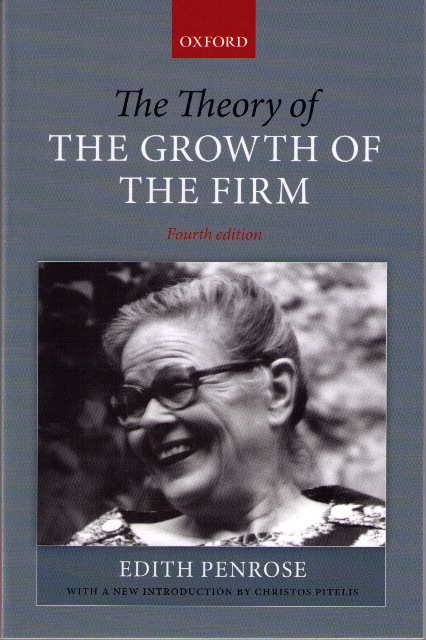 This year marks the 50th anniversary of Edith Penrose’s Theory of the Growth of the Firm (1959), one of the most important and influential books on the firm and firm strategy. To celebrate, Yasemin Kor and Christos Pitelis organized a roundtable at last week’s SMS conference with remarks by Christos, Yasemin, Joe Mahoney, Margie Peteraf, and Maurizio Zollo. The participants have graciously allowed me to post their slides and materials (1, 2, 3, 4). Christos, Penrose’s friend and literary executor, has edited and introduced a new edition of the 1959 book, which you can purchase here. You can read his introduction here. Nice!
Penrose trivia: During the 1950s Murray Rothbard made his living by reviewing literature and grant proposals for the William Volker Fund. When going through Rothbard’s correspondence a few years ago I came across a proposal for a study on firm growth submitted jointly by Penrose and Fritz Machlup, her dissertation supervisor at Johns Hopkins. Apparently at one point, the book was going to be a joint project. (Rothbard thought the ideas in the proposal didn’t fit with Penrose’s earlier warnings about the use of biological analogies in economics. However, as Joe Mahoney has noted, there is no inconsistency between the 1952 article and the 1959 book; Penrose is careful in her work on growth not to treat growth tendencies in firms as automatic, but to model them based on the preferences, beliefs, and actions of the firm’s personnel. In other words, she accepts natural selection in this context but not random mutation.)
BTW, what other important works in our field appeared in 1959, to be celebrated this year? Coase’s article on the Federal Communications Commission is one. The 1970s may have been the golden decade but there were major contributions in the previous decades as well. What are your favorites? Whose anniversary should we be preparing to celebrate?
Williamson’s “Economics of Institutions” Syllabus
| Peter Klein |
I was pretty clueless when I started graduate school. I had good undergraduate training in economics, and had the privilege of attending my first Austrian seminar, where I met Murray Rothbard, Hans Hoppe, Roger Garrison, and David Gordon, before beginning graduate work. But I really didn’t know exactly what I wanted to study. Like most economics PhD students, I wasn’t exactly turned on by the core theory and econometrics classes. Then I took Williamson’s course ECON 224, “Economics of Institutions,” and it was a revelation. The syllabus dazzled me, with readings from Coase, Simon, Hayek, North, Arrow, Chandler, Alchian, Demsetz, Ben Klein, and many other brilliant and thoughtful economists, along with sociologists, political scientists, historians, and others. I decided then that institutions and organizations would be my area, and I’ve never looked back.
Since Monday I’ve been digging through my files trying to find a copy of that syllabus. I found my folder for that course, containing notes, readings, and exams (no, you can’t see my test scores), but for some reason the syllabus has disappeared. I must have taken it out to study, perhaps when designing my own course in institutions and organizations, and it didn’t make its way back into the file. But I did find an older copy, the Fall 1988 edition. That was, I believe, Williamson’s first year at Berkeley, after arriving from Yale (where he didn’t teach PhD courses, his main appointment being in the law school). I took the course in 1989, but the syllabi are very similar. So here it is. Note the range of authors, journals, subject areas. Not at all like the typical economics PhD course!
Williamson and the Austrians
 | Peter Klein |
My short piece on Williamsonian transaction cost economics and its relationship to the Austrian approach is up on Mises.org.
Williamson Miscellany, Continued
| Peter Klein |
5. Many useful summaries of Williamson’s (and Ostrom’s) contributions are appearing online, such as those by Ed Glaeser, David Henderson, John Nye, Jeff Ely, and Alex Tabarrok. I think the first few pages of my “make-or-buy” chapter in the NIE Handbook provide a decent overview too. I also have some slides on transaction cost economics (part 1, part 2) that may be helpful for those seeking more detail.
6. Joshua Gans credits me with anticipating the award, which is nice, but undeserved — it was just wishful thinking on my part!
7. Oliver’s son Dean reports that he’s having trouble getting through to his folks: “The house in Berkeley had become such a media circus with every media entity from UPI to Al Jazeera trying to get through that I’ve been holding off with some of my own phone calls.” More important, Dean says his dad
has had a good attitude about these things. For years Berkeley would ask him to sign off on candidate press releases. But this would just get him a little worked up, and he might have a hard time getting to sleep. Could they stop that, please? On top of that, he appreciates that life has been good. No complaints, no reason to get worked up. Better to be Zen about the whole thing.
8. Scott Masten tells me O&M made a list of 100 best professor blogs. Scott and I agree that Williamson would gladly trade the Nobel prize for this honor instead. (more…)
Hoisted from the Comments: Hoopes on Williamson
| Peter Klein |
Former guest blogger David Hoopes’s comment deserves its own post:
So, we’re leaving the serious discussion to our goody two-shoes organizations twin? Was Will Mitchell a Williamson student? No one has said anything about Teece. Teece’s early JEBO articles did a great job talking about economies of scope and transaction cost influences on strategy.
Unmentioned yet, there has been some contentious discussion about the implications of TC economics on strategy and organization. Many including Connor and Prahalad consider the implications of TC to lead to bad management and bad strategy. However, our very own Steve Postrel wrote a great paper, “Islands of Shared Knowledge” that (esp in an earlier version) does a great job of comparing and contrasting the RBV and TC as theories of the firm.
Harold Demsetz weighed in on this earlier in his, “Theory of the Firm Revisited” (which is one of my favorite all time papers). Harold argues that firms would exist without governance problems. Steve has tried to get Harold to see the light (i’m not sure i do) but to no avail.
Of course, CERTAIN org theorists, whose names i do not mention think that Williamson’s logic, as does all competition-based economic theory, leads to evil and terrible results: unethical business students who become tomorrow’s headlines.
I’m very happy to see Williamson win. His influence on strategy and organization is immense. And, at this point, I don’t see any theory of the competitive firm can reasonably leave him out. I will admit, in terms of competitive heterogeneity and competitive advantage I don’t think governance is anywhere near as important as productive capabilities. BUT, capabilities literature still has a lot of work to do to be specified as exactly as TCE.
David, more serious discussion is on the way. Unfortunately, we O&Mers have higher opportunity costs than the bloggers at our good-twin site, so we can’t get the posts up as quickly as they can. :-)
Williamson Miscellany
| Peter Klein |
1. I’ve been at the SMS conference, and traveling, and haven’t had a chance to read the vast blogospheric commentary on Williamson (and Ostrom). Those looking for an introduction to Williamson’s work will find good stuff in the forthcoming Elgar Companion to Transaction Cost Economics, including an introduction by Williamson himself, and chapters on core subjects by eminent Williamsoninans.
Briefly, my own (admittedly biased) take is that Williamson is second only to Coase as the key figure in modern organizational economics. Moreover, his work has revolutionized the way economists (and some antitrust lawyers) understand markets. The perfectly competitive general-equilibrium model, Williamson’s work shows, is unrealistic, irrelevant, and a distraction. The task of economists studying firms and markets is to understand the marvelous variety of organizational forms that emerge in competitive markets, virtually none resembling the “firm” of microeconomics textbooks (what Williamson calls the production-function picture of the firm). “Nonstandard” phenomena like vertical integration, vertical contractual restrictions, alliances and joint ventures, long-term supply or distribution agreements, and the like should be celebrated, not condemned. (Williamson is more circumspect, arguing that each form of organization should be evaluated on the merits, case by case — a refreshing contrast to the standard approach in antitrust law, which is to assume that every deviation from perfect competition is “anticompetitive.”)
2. The Nobel Committee’s scientific statement cites one of my papers. How cool is that? Coauthor Howard Shelanski tells me that law professors note on their CVs if one of their articles is cited in a Supreme Court decision. You can be sure I’ll find a way to list this on mine. (more…)
Wiliamson Linking with Guile
| Lasse Lien |
Now that Williamson got what he deserved, the race is on to associate oneself as closely as possible with the great man (Williamson linking with guile). Some try to link him to their research field, saying that he is really in sociology, strategy, organization theory, IO, or whatever is their own field. Some go for the personal link: “I know him like the inside of my pocket,” or “he is like a father/son to me.” My version will be the institutional link (which seems appropriate for Williamson). My own institution gave Williamson his first honorary doctorate, at the initiative of my own department. Apparently we recognized greatness quite early. Unfortunately this was back in 1986, well before my time.
Williamsoniana
| Peter Klein |
My, we live in a fast-paced world: the Nobel announcement is just a few hours old, and we’re already being taken to task for not blogging enough about Williamson. For the high-time-preference folks, please see previous posts on Williamson and transaction cost economics, and the preview chapters of the Elgar TCE Handbook, while we work on our usual careful, thoughtful, and well-researched blog posts.
It’s Williamson, at Last!
 | Peter Klein |
A hearty congratulations to Oliver Williamson, co-recipient (along with Elinor Ostrom) of this year’s Nobel Prize in economics. As Williamson’s former PhD student, I’m thrilled beyond belief. The O&M crew have all been heavily influenced by Williamson (and, to a some degree, Ostrom too) and will have much more to say about this in the coming days. But, for now, just enjoy!
Stewart Macaulay
| Peter Klein |
Here’s a lecture I wish I could have attended: Stewart Macaulay gave today’s Annual Distinguished Lecture at BYU Law School. Macaulay, as noted in BYU’s blurb, is “an internationally recognized scholar and a leader of the law-in-action approach to contracts. He pioneered the study of business practices and legal work regarding contract law. He is also one of the founders of the law and society movement.” More important for our purposes, Macaulay’s emphasis on what Williamson calls “private ordering” — the governance of contractual relations by convention, private arbitration, and firms’ own “internal courts” — has been extremely influential for transaction cost economics.
Here’s the abstract of Macaulay’s lecture:
A Contract Crisis? “It Ain’t Necessarily So.”
There are several proposals for a new contract law. On one hand, our economic crisis suggests that many see the need to rewrite or rescind contracts to reflect the drastically changed conditions of the past few years. On the other hand, there are proposals for a far more formal law of contracts than are found in the Uniform Commercial Code and the Restatement (2d) Contracts. Drawing on calls for “a new legal realism,” Professor Macaulay suggests that there is much that we don’t know about the need for and the consequences of such major revisions. He stresses, however, that a key word in Ira Gershwin’s lyrics from “Porgy and Bess” is “necessarily.” The first step must be a better picture of contract law in action. Such a picture might support some but not other changes.
I hope the lecture will appear soon on Macaulay’s website, and that Gordon Smith will post reactions at the Glom.
Elgar Companion to Transaction Cost Economics
| Peter Klein |
Mike Sykuta and I are editing a volume for the Elgar Companion series, The Elgar Companion to Transaction Cost Economics. The volume is currently in production with an expected publication date in mid-2010. We’ve created a page here on O&M with more information, including a table of contents and some sample chapter drafts. Enjoy!
Alchian and Demsetz (1972), Dallas Cowboys Edition
| Peter Klein |
In Alchian and Demsetz’s (1972) nexus-of-contracts approach to the firm, bosses don’t necessarily hire workers; workers may just as easily hire bosses. Recall Cheung’s (1983, p. 8) famous illustration: “My own favorite example is riverboat pulling in China before the communist regime, when a large group of workers marched along the shore towing a good-sized wooden boat. The unique interest of this example is that the collaborators actually agreed to the hiring of a monitor to whip them.” In Alchian and Demsetz’s example, the employee can “fire” his employer by quitting, just as I can “fire” my grocer by shopping at a different store.
Here’s the Onion applying this logic to the NFL’s Dallas Cowboys:
IRVING, TEXAS — In an attempt to cut the franchise’s losses and “move forward in a positive direction,” the Dallas Cowboys severed ties with controversial owner Jerry Jones Monday, ending their tumultuous 20-year relationship with the divisive figure.
According to sources within the Cowboys organization, the decision to release Jones was influenced by the lack of any playoff victories in more than 12 years, the owner’s distracting sideline antics, and his selfish, “me first” attitude, which many said was having a cancerous effect on the clubhouse.
“We value Jerry’s contributions to the Cowboys over the past two decades, but it has become painfully clear that we just don’t share the same priorities,” Cowboys public relations director Richard Dalrymple said. “This wasn’t an easy choice to make, but we’re confident it is a decision that can only make our team better.”
I can see it now: “An NFL owner has no power of fiat, no authority, no disciplinary action any different in the slightest degree from ordinary market contracting between any two football players. . . .”
Another Nanosecond of Fame
| Dick Langlois |
Warm thanks to Art Diamond for his very nice review on eh.net of my book The Dynamics of Industrial Capitalism: Schumpeter, Chandler and the New Economy. I am most pleased that Art recognizes the book to be primarily theory, albeit with much discussion of economic history and economic ideas.
Short Piece on Probability Theory
| Peter Klein |
“Risk, Uncertainty, and Economic Organization” is my contribution to the Hoppe Festschrift. I got the topic idea from some blogger guy. My chapter focuses, as the title suggests, on Knightian uncertainty. Hoppe places Knight, along with Ludwig von Mises, squarely in the frequentist camp (typically associated with Ludwig’s brother Richard). I tend to agree with Hoppe although, as I discuss in the paper, there are many interpretations of Knight, and some commentators argue that subjective (Bayesian) probability theory renders untenable the Knightian distinction between insurable risk and true uncertainty (see, for example, Dick’s 1982 paper).
Ultimately, however, I don’t think the approach to the firm promoted on this blog depends on a particular interpretation of Knight. The central claim is that judgment represents a kind of decision-making that cannot be traded on the market, and that therefore requires the entrepreneur exercising such judgment to establish a firm (more specifically, to take ownership of capital resources). To put it differently, ownership of assets implies a kind of ultimate responsibility that the owner cannot delegate. I think one can be agnostic about exactly why judgment isn’t tradable — it could be a form of asymmetric information, rather than ontological differences between types of knowledge — and still buy the basic Knight-Mises-Foss-Klein approach to the firm.
Alliances and Internal Capital Markets
| Peter Klein |
An interesting contribution to the literature on internal capital markets from David Robinson, “Strategic Alliances and the Boundaries of the Firm,” appeared recently in the Review of Financial Studies (now the third-ranked journal in finance behind the JF and JFE):
Strategic alliances are long-term contracts between legally distinct organizations that provide for sharing the costs and benefits of a mutually beneficial activity. In this paper, I develop and test a model that helps explain why firms sometimes prefer alliances over internally organized projects. I introduce managerial effort into a model of internal capital markets and show how strategic alliances help overcome incentive problems that arise when headquarters cannot pre-commit to particular capital allocations. The model generates a number of implications, which I test using a large sample of alliance transactions in conjunction with Compustat data.
The model builds on Williamson’s concept of forbearance, the idea that courts will enforce contracts between distinct legal entities but will not intervene in intra-firm disputes. The idea is that moving project with particular characteristics — Robinson calls them “longshots” — from a subunit of a diversified firm to an alliance partner allows the firm’s management to make a credible commitment not to expropriate value from the project manager ex post. Empirical evidence shows that projects with longshot characteristics, measured in various ways using Compustat segment data, are indeed more likely to undertaken by alliance partners. A nice paper with a good mix of theory and evidence.





 Organizations and Markets
Recent Comments