Posts filed under ‘Theory of the Firm’
Organizing for Synergies
| Peter Klein |
Thanks for Mike S. for the pointer to this paper (published version here, ungated version here):
Organizing for Synergies
Wouter Dessein, Luis Garicano, and Robert GertnerLarge companies are usually organized into business units, yet some activities are almost always centralized in a company-wide functional unit. We first show that organizations endogenously create an incentive conflict between functional managers (who desire excessive standardization) and business-unit managers (who desire excessive local adaptation). We then study how the allocation of authority and tasks to functional and business-unit managers interacts with this endogenous incentive conflict. Our analysis generates testable implications for the likely success of mergers and for the organizational structure and incentives inside multidivisional firms.
This is an understudied topic in organizational design, I think. The large literature on the M-form, going back to Chandler and Williamson and flourishing in the 1970s and 1980s, compared functional to business-unit managers across organizations, but said much less about mixing them within organizations. The modern internal capital markets literature focuses on information problems between division heads and the central office, and conflicts over resources among division heads, but not the issues raised here by Dessein, Garicano, and Gertner. The vertical integration literature, as well, tends to treat firm-wide support services as peripheral to the incentive conflicts between vertically related divisions.
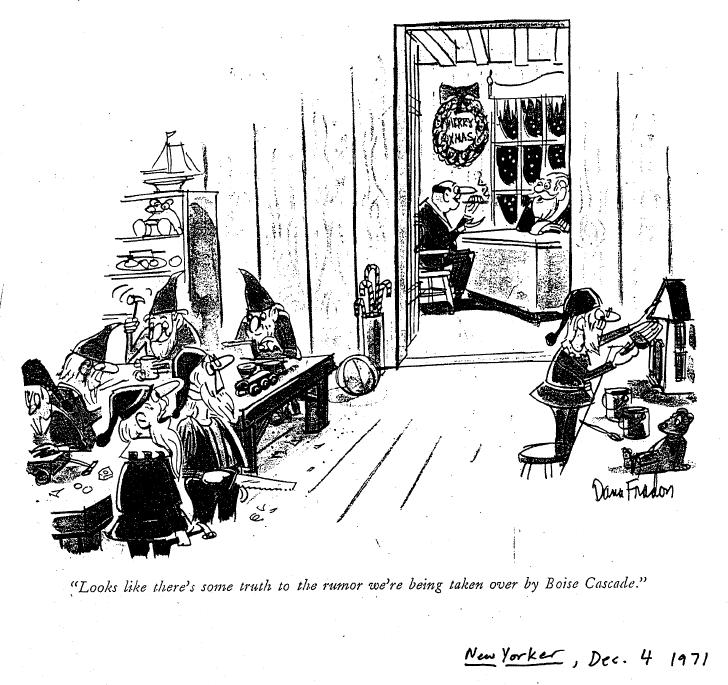
Unrelated Diversification, circa 1971
| Peter Klein |
A funny (to me) New Yorker cartoon about diversification, appearing at the height of the conglomerate merger wave of the late 1960s and early 1970s. Click to enlarge. (I’ve been looking for this for a while; found it when cleaning out an old file cabinet.)
University Restructuring, Agricultural Economics Edition
| Peter Klein |
The current issue of AAEA Exchange, the newsletter of the Agricultural and Applied Economics Association (formerly American Agricultural Economics Association), features three perspectives on the long-term viability of maintaining separate departments of economics and agricultural economics. (Much of the discussion would apply to business economics departments too.) Ron Mittelhammer of Washington State argues for consolidation, Ken Foster of Purdue for keeping separate departments, and Rob King of Minnesota for the transformation of agricultural economics departments to applied economics departments.
The issues are organizational and strategic and familiar to O&M readers. Mittelhammer emphasizes tangible resources and a shared intellectual heritage and downplays accumulated routines and capabilities, organizational culture, etc.:
Arguably above all other rationale, mergers are also warranted because, fundamentally, economics is economics. Agricultural economics is a field of economics, not some other paradigm of economics, and is no more distinct from its parent discipline than other fields such as labor economics, international economics, health economics. . . .
Too often of late, it appears that the last ditch attempt at justifying the separation of economic units degenerates to the issue of faculty personalities, the correlated issue of seemingly unbridgeable differences in “professional cultures,” and the fear of open faculty warfare that might be ignited by a merger, rather than the existence of truly distinct and defensible differences in the methodologies used to do economic analysis in agricultural and applied, versus the “other” economics disciplines. (more…)
New Coase Interview
| Peter Klein |
In conjunction with Ronald Coase’s new book on China, he’s given a new interview to his co-author Ning Wang. (HT: Paul Walker via Mike Giberson.) Excerpt:
WN: You mentioned many times that you do not like the term, “Coasean economics,” and prefer to call it simply the “right economics” or “good economics.” What separates the good from bad, the right from wrong?
RC: The bad or wrong economics is what I called the “blackboard economics.” It does not study the real world economy. Instead, its efforts are on an imaginary world that exists only in the mind of economists, for example, the zero-transaction cost world.
Ideas and imaginations are terribly important in economic research or any pursuit of science. But the subject of study has to be real.
I’m sympathetic to this, but with some methodological reservations, expressed at the end of this post. Anyway, the interview focuses on China, its future economic prospects and likely influence, and the newly formed Coase China Society. Coase is bullish on China: “In the past, economics was once mainly a British subject. Now it is a subject dominated by the Americans. It will be a Chinese subject if the Chinese economists adopt the right attitude.” (more…)
AEA Papers on Organizations, Institutions, and Entrepreneurship
| Peter Klein |
O&M readers attending the American Economic Association annual meeting in Denver may find these papers of particular interest:
Industrial Policy, Entrepreneurship, and Growth
PHILIPPE AGHION (Harvard University)Does Management Matter: Evidence from India
NICHOLAS BLOOM (Stanford University)
BENN EIFERT (University of California-Berkeley)
APRAJIT MAHAJAN (Stanford University)
DAVID MCKENZIE (World Bank)
JOHN ROBERTS (Stanford University)Efficiency and Adaptation in Organizations and Institutions
PETER G. KLEIN (University of Missouri-Columbia)
JOSEPH T. MAHONEY (University of Illinois)
ANITA M. MCGAHAN (University of Toronto)
CHRISTOS N. PITELIS (University of Cambridge)The Coevolution of Culture and Institutions in Seventeenth Century England
PETER MURRELL (University of Maryland) (more…)
The Future of Managerial Economics
| Peter Klein |
The December 2010 issue of Managerial and Decision Economics features an editorial by Paul Rubin and Tony Dnes on the state of the field, “Managerial Economics: A Forward Looking Assessment.” As they note, the “traditional approach” — basically applied neoclassical microeconomics, production theory in particular — has been augmented by new developments,
particularly in areas such as globalization, the economics of organization, information economics, strategic behavior, the learning organization, risk management, business ethics, and behavioral economics. All of these topics are hot in modern managerial economics and are slowly feeding through into MBA and similar courses.
The modern trends are often referred to as “the new managerial economics.” Some modern texts even use the term explicitly (Boyes, 2008) and focus on questions of “organizational architecture” including areas such as incentive structures in personnel economics. There are increasing numbers of specialist works emerging in these areas, which are coming to feature in influential handbooks (Lazear, 2009). Personnel economics, for example, applies economics to human resources topics, including information interactions, problems of team coordination, morale, and seniority systems. . . . In managerial terms, this field is a natural development of the economics of organization and of labor economics, and we hope to see much future research coming through. (more…)
Google Tries Selective Intervention?
| Peter Klein |
Can a large firm do everything a collection of small firms can do, and more? If not, how do we understand the limits to organization? Arrow focused on the information structure inside firms. I favor Mises’s economic calculation argument. Williamson’s preferred explanation for the limits to the firm is the impossibility of selective intervention — the idea that higher-level managers cannot credibly commit to leave lower-level managers alone, except when such selective intervention would generate joint gains. Williamson’s argument is not, however, universally embraced (or even understood the same way — see the comments to Nicolai’s post).
Google apparently sees things Williamson’s way and has formulated an explicit policy on “autonomous units” designed to address the problem. Such units “have the freedom to run like independent startups with almost no approvals needed from HQ, ” reports TechCrunch. “For these divisions, Google is essentially a holding company that provides back end services like legal, providing office space and organizing travel, but everything else is up to the pseudo-startup.” Can it work? Insiders are doubtful. The TechCrunch reporter even frames Williamson’s thesis in this folksy way:
There’s a lie that companies and entrepreneurs tell themselves in order to commit to an acquisition.
Oh, we’re not going to change anything! We’re just going to give you more resources to do what you’ve been doing even better!
Yeah! They bought us for a reason, why would they ruin things?
It usually works for a little while, but big company bureaucracy– whether it’s HR, politics or just endless meetings– almost always creeps in. It’s a law of nature: Big companies just need certain processes to run and entrepreneurs hate those processes because they stifle nimble innovation.
Coordination Problems in the Theory of the Firm
| Nicolai Foss |
Many textbooks (e.g., this one or this one) begin by noting that there are two fundamental problems of economic organization, namely the coordination problem and the motivation problem — and then devote 95% of the space to the latter problem. (In a paper published in 1993 (but written in 1989), I proposed that extant theories of the firm could be understood as taking either a PD (-like) game or a coordination game as the fundamental underlying structure of interaction. In my reading, capabilities theories were about coordination problems, while mainstream organization economics fundamentally started from PD-like situations; this paper develops the argument a little bit).
Important work has been done on coordination problems in the context of the theory of the firm by Colin Camerer and Mark Knez (e.g., here), Phanish Puranam and Ranjay Gulati (here), Luis Garicano (e.g., here), Birger Wernerfelt (e.g., here), and, of course, co-blogger Dick Langlois (check his CV here on O&M — most of his stuff on economic organization is about coordination). One could also make the point that large parts of traditional organizational design theory (of the information processing/contingency variety, including Marschak & Radner’s team theory) are really about coordination problems rather than motivation problems. Dick Langlois has long argued that Coase (1937) is fundamentally about coordination rather than motivation.
This is definetely something; however, compared to the enormous outpouring of work on motivation problems, it is fair to say that coordination problems are neglected, although there are reasons to suppose that they are quite important: There are plenty of examples of highly motivated people utterly failing with respect to organizing and coordinating.
I just came across an excellent paper, “Coordination Neglect: How Lay Theories of Organizing Complicate Coordination in Organization,” that deals with a number of obstacles to coordination rooted in heuristics (“lay theories”) that individuals apply, for example, when setting up a division of labour in an organization. Notably, individuals systematically neglect task interdependencies. They also fail to communicate sufficiently because of knowledge bias and they are poor at translating problems for others. There are plenty of useful illustrations and anecdotes in the paper, making it excellent as a companion to a traditional motivation/incentive-focused textbook in a theory of the firm class. Highly recommended!
The Economist on Coase at 100
| Peter Klein |
 The new Economist celebrates Ronald Coase’s 100th birthday (this coming Wednesday) with a short piece on “The Nature of the Firm” (1937), the founding document of modern organizational economics (16,379 Google Scholar cites). (Thanks to Avi for the pointer.) It’s nice to see the theory of the firm get its props, and the first few paragraphs do a good job summarizing the paper. But the (anonymous) author has misread the modern literature, first in setting up an artificial conflict between Coase’s transaction-cost approach and the resource-based approach to the firm and, second, by missing the depth and nuance of Coase’s own research program.
 On the first point: Much recent work tries to reconcile transaction cost economics (TCE) and the resource-based view (RBV) (e.g., Silverman, 1999; Foss and Langlois, 1999; Tsang, 2000; Madhok, 2002; Foss and Foss, 2005), pointing out that the two theories are, in important ways, complementary. Put simply: TCE and RBV start with different explananda. The RBV asks which resources will be combined in which ways to produce which outputs, while TCE asks how this activity will be organized (market, hierarchy, or hybrid). RBV offers a theory of competitive advantage, while TCE focuses on boundaries and governance. Second, the Economist writer confuses Coase with the (Coase-inspired) transaction cost approach of Williamson (1971, 1975, 1979) and Klein, Crawford, and Alchian (1978): (more…)
Short Course on Network Economics
| Peter Klein |
 I’m teaching a five-week, online course starting in January called “Networks and the Digital Revolution: Economic Myths and Realities.” It’s offered through the Mises Academy, an innovative course-delivery platform that is becoming its own educational ecosystem. A description and course outline is here, signup information is here. I’d love to have you join me!
“Robert S. McNamara and the Evolution of Modern Management”
| Peter Klein |
That’s the title of a new HBR article by Phil Rosenzweig (author of the excellent Halo Effect). I’ve been interested in McNamara and his role in business history since grad school, when I was researching “management by the numbers” and similar techniques that flourished during the conglomerate boom in the 1960s. (See previous O&M posts on McNamara here and here.) Rosenzweig provides a nice summary of some of strengths and weaknesses of McNamara’s dispassionate, “rational,” quantitative approach (see especially the sidebar, “What the Whiz Kids Missed”). Lots of information and ideas related to decision theory, organizational design, multitasking, performance evaluation, innovation, etc. Excerpt:
Whether at Ford or in the military, in business or pursuing humanitarian objectives, McNamara’s guiding logic remained the same: What are the goals? What constraints do we face, whether in manpower or material resources? What’s the most efficient way to allocate resources to achieve our objectives? In filmmaker Errol Morris’s Academy Award–winning documentary The Fog of War, McNamara summarized his approach with two principles: “Maximize efficiency” and “Get the data.”
Yet McNamara’s great strength had a dark side, which was exposed when the American involvement in Vietnam escalated. The single-minded emphasis on rational analysis based on quantifiable data led to grave errors. The problem was, data that were hard to quantify tended to be overlooked, and there was no way to measure intangibles like motivation, hope, resentment, or courage. . . .
Equally serious was a failure to insist that data be impartial. Much of the data about Vietnam were flawed from the start. This was no factory floor of an automobile plant, where inventory was housed under a single roof and could be counted with precision. The Pentagon depended on sources whose information could not be verified and was in fact biased. Many officers in the South Vietnamese army reported what they thought the Americans wanted to hear, and the Americans in turn engaged in wishful thinking, providing analyses that were overly optimistic.
Palgrave Entry on Oliver Williamson
| Scott Masten |
If you have access to The New Palgrave Dictionary of Economics, Online Edition, my entry on Oliver Williamson is now available: Oliver E. Williamson.
Mirowski on Backhouse and Fontaine, eds., The History of the Social Sciences since 1945
| Peter Klein |
I enjoyed Philip Mirowski’s first book, though I find his more recent stuff increasingly tendentious and repetitive. Still, a Mirowski review of Backhouse and Fontaine, eds., The History of the Social Sciences since 1945 (Cambridge, 2010) is worth a read. Interesting bit on organizational structure:
The historical generalization overlooked by the editors is that “interdisciplinary” social science units shoehorned into postwar university structures almost uniformly failed, whereas those founded as freestanding think tanks, from RAND to American Enterprise Institute to Cato and the Manhattan Institute, all persevered and succeeded. This is true even for the odd case of Carnegie GSIA, which became the model for other business schools across the nation, but only upon dispensing with the original interdisciplinary structures initially promoted by Herbert Simon (himself then exiled to a Department of Psychology). The lesson may be that the postwar American research university could not sustain true interdisciplinarity in social science inquiry, but that military and corporate sponsors of the think tanks could manage it, but only by yoking it to a format that enforced unquestioned responsiveness to the whims of the funders.
A familiar point of course to students of entrepreneurship and innovation, and yet another reason to suspect that innovation in higher education is more likely to come from outsiders (e.g., the notorious for-profit institutions) than incumbents.
Interesting New Books
| Peter Klein |
In place of the “What I’ve Been Reading Lately” posts that show up regularly on certain blogs, I hereby offer something slightly less egocentric, the “What I’ve Been Receiving Lately” post. It contains a list of books I’ve recently received by mail, some by choice, others because publishers sent them (perhaps hoping I’d blog about them — Mission Accomplished!). Not the most scientific sample selection process, but there you go.
- Jesús Huerta de Soto, Socialism, Economic Calculation, and Entrepreneurship (Elgar, 2010). English translation of an important work first published in Spanish in 1992.
- Guinevere Liberty Nell, Rediscovering Fire: Basic Economic Lessons from the Soviet Experiment (Algora, 2010). What the failure of central planning teaches about markets and institutions.
- Koray Çaliskan, Market Threads: How Cotton Farmers and Traders Create a Global Commodity (Princeton, 2010). Economic sociology meets global commodity systems. Contains dust-jacket endorsements from Richard Swedberg and Donald MacKenzie, so expect a review from the orgtheory boys soon.
- Peter J. Boettke, ed., Handbook on Contemporary Austrian Economics (Elgar, 2010). Essays by young Austrian economists associated with George Mason University.
- Robert E. Wright, Fubarnomics: A Lighthearted, Serious Look at America’s Economic Ills (Prometheus, 2010). I think the title says it all.
- Ranjay Gulati, Reorganize for Resilience: Putting Customers at the Center of Your Business (Harvard Business School, 2010). Looks fluffy, but I have a teaching interest in change management so I’ll give it the benefit if the doubt.
- David Stark, The Sense of Dissonance: Accounts of Worth in Economic Life (Princeton, 2009). Also deals with organizational change, but in a more serious way. Ethnographic studies of three organizations dealing with large exogenous shocks. Looks interesting.
Random Thoughts on Strategic Entrepreneurship
| Peter Klein |
A few insights, interesting facts, provocative statements, and other things I managed to remember from the conference:
- As Nicolai mentioned in his post below, there is a lot of exciting work out there on the links between organizational design and characteristics (HRM practices, organizational culture, social learning processes, team characteristics, etc.) and entrepreneurial behavior. This is clearly a hot topic at the boundary of the strategic management, organizational behavior, entrepreneurship, and innovation literatures.
- This emerging literature is pretty eclectic, theoretically and empirically. The conference featured papers with formal models, conceptual theory papers, conventional econometric papers, simulation papers, and of course thought-provoking keynote addresses. The participants came from a variety of academic backgrounds and specialty areas.
- It’s a young field. The four keynote speakers (Mike Wright, Bill Schulze, Shaker Zahra, and Jeff Hornsby) are pioneers in the field, and not that old. (Shulze noted that he had been present “at the birth” of the modern entrepreneurship field, and he looks pretty spry and vigorous to me.)
- The empirical literature still struggles to operationalize entrepreneurship in a meaningful way. Despite various sermons about entrepreneurship being a generalized function, rather than a job description or firm type, most empirical papers use self-employment, management of particular kinds of firms, etc. as proxies. (I’m guilty of this myself, of course.) (more…)
The Thin Mint Effect
| Peter Klein |
 A new study finds that as nonprofit organizations increase their for-profit activities, the share of resources going to the core mission decreases. (Thanks to Fast Company for the link and the Thin Mint reference.)
This strikes me as a good illustration of multitask principal-agent problems. The output of for-profit activities is more easily measured than the output of nonprofit activities, giving agents (under performance-based pay) the incentive to increase effort toward those for-profit activities. Mises’s discussion of performance measurement and delegation in Bureaucracy comes to mind as well.
CFP: Searle Center Conference on Entrepreneurship and Innovation
| Peter Klein |
I’m a big fan of the Searle Center conferences on entrepreneurship and innovation, organized by Dan Spulber. The Call for Papers for the fourth annual conference, 16-17 June 2011, has just been distributed. “The goal of this conference is to provide a forum where economists and legal scholars can gather together with Northwestern’s own distinguished faculty to present and discuss high quality research relevant to entrepreneurship and innovation.” Details below the fold. (more…)
Congratulations to J. C. Won
| Peter Klein |
Congratulations to University of Missouri PhD student Jong Chul Won for being one of three Don Lavoie Memorial Essay Competition Winners for 2010. His paper is “The Emergence, Limit, and Distortion of the Firm: The Entrepreneurship Approach.” The contest is sponsored by the Society for the Development of Austrian Economics. Details are below the fold.
Missouri student Per Bylund was a 2009 winner at the Austrian Student Scholars Conference for his paper “The Theory of the Firm: Coasean Misconceptions and Austrian Solutions.” If you’re interested in entrepreneurship and the theory of the firm, particularly from an Austrian perspective, the University of Missouri is the place to be! (more…)
The Legacy and Work of Douglass North
| Peter Klein |
Washington University, St. Louis is hosting a major international conference, 4-6 November, on the Legacy and Work of Douglass North. The all-star panel includes Lee Alston, Robert Bates, Joel Mokyr, Elinor Ostrom, Ken Shepsle, Barry Weingast, and many others. The conference is organized by Wash U’s Center for New Institutional Social Science.
In other conference news, the CFP for next year’s Atlanta Competitive Advantage Conference, 17-19 May 2011, has been posted. Featured presenters include Jay Barney, Joel Baum, and Rebecca Henderson.
Assorted Links
| Peter Klein |
- A new paper by Randall Morck and Bernard Yeung, “Agency Problems and the Fate of Capitalism.” A very good comparative-institutional analysis of shareholder democracy and its benefits and costs relative to “stakeholder” models.
- A Washington Post story on “moral licensing” (via Sheen Levine) — suggesting that some people view ethical behavior, like goods and services, in terms of trade-offs at the margin!
- A call for contributions to The Ethics and Economics of Agrifood Competition, a Springer volume in preparation by my colleague Harvey James.
- Videos and papers from the Coase centenary conference held last year at the University of Chicago Law School.





Recent Comments