Posts filed under ‘People’
Competitive Advantage, Network Advantage, and Vienna
| Peter Klein |
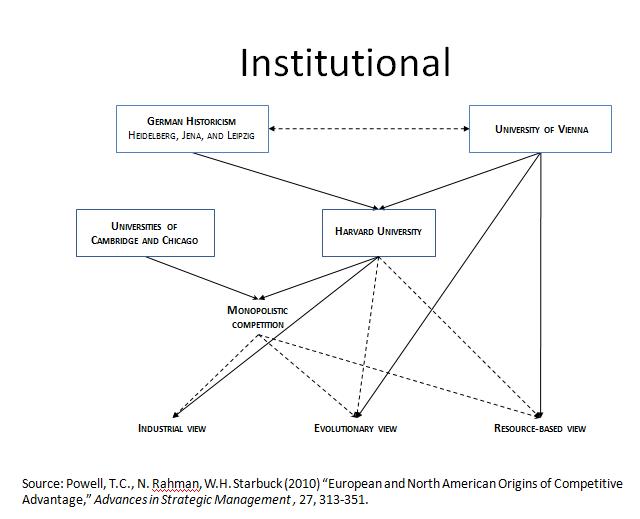
At last week’s ACAC Joel Baum gave a very interesting presentation (ppt) on the institutional and intellectual histories of two important strands in management thought, the literature on competitive advantage and the literature on network advantage. These two strands developed largely in isolation but, as it turns out, can both trace important parts of their development to the University of Vienna and the Austrian school of economics. Check out the genealogies below, captured from Joel’s slides. First, two diagrams on the origins of the competitive advantage approach (click to enlarge):

Now, two on the origins of network advantage theory: (more…)
Mitch on Hoselitz
| Peter Klein |
The following is a guest post from David Mitch, Professor of Economics at the University of Maryland, Baltimore County and an expert on Bert Hoselitz.
The reasonably recent postings on this blog on Bert Hoselitz prompt me to post a correction to my biographical piece on him for the Elgar Companion to the Chicago School of Economics (2010) edited by Ross Emmett and also to make some further comments regarding Hoselitz’ “Austrian” origins. Both the correction and futher observations stem from Yvan Kelly’s very interesting article “Mises, Morgenstern, Hoselitz, and Nash: The Austrian Connection to Early Game Theory” published in the Quarterly Journal of Austrian Economics 12, no. 3 (2009).
The correction to my piece is as follows. On p. 274 of my piece, I state that “Prominent leaders of the Austrian School of Economics such as Ludwig Mises and F. A. Hayek had departed Vienna by the time Hoselitz began his university studies.” Yvan Kelly indicates on p. 38 of his article that Hoselitz attended two of Mises’ seminars in 1933 and 1934 based on correspondence that Hoselitz sent to Mises in 1941. I have not yet seen copies of this correspondence. However, I was clearly in error in stating that Mises had departed Vienna by the time Hoselitz began his university studies. Klaus Herdzina’s (1999) biographical essay on Hoselitz cited in my piece indicates that Hoselitz studied at the University of Vienna between 1932 and 1937. I do not know from what sources Herdzina obtained this information; but I based the statement in my own piece that Hoselitz studied at the University of Vienna between 1932 and 1937 on Herdzina’s essay. Hulsmann’s 2007 biography of Mises (p. 678) indicates that Mises stopped his private seminar and left Vienna in 1934. Thus, it would appear that Hoselitz’ studies at the University of Vienna did overlap with the period that Mises was in Vienna and leading his private seminar. And this would thus be consistent with the possibility that Hoselitz attended some of Mises’ seminars. So again, the statement in my piece for the Elgar Companion that Mises had departed Vienna by the time Hoselitz started his studies at the University of Vienna would definitely seem to be in error assuming the Herdzina is correct in his dating of when Hoselitz studied at the University of Vienna. (more…)
Contributions from Mature Scholars
| Peter Klein |
Following up my earlier post on Austrian longevity: Rafe Champion notes that Max Weber died suddenly of pneumonia, in 1920, at age 56. What important further contributions might he have made if he had lived longer?
This prompts the thought, what would have been lost if some long-lived Austrians [and fellow travelers] had died at 56? For Mises, that was 1937, before his masterwork was completed (later translated as Human Action) and before he was a living presence in the US.
For Hayek, that was 1954. No Constitution of Liberty and later works, no Nobel Prize.
For Popper, 1958, before The Logic of Scientific Discovery appeared in English and a dozen other books apart from The Open Society and The Poverty of Historicism.
Coase turned 56 in 1966, with several important contributions still to come: the 1970 paper on durable-goods monopoly, the 1974 paper on the lighthouse, and his recent papers on Fisher Body, not to mention the Nobel Prize and his crowning achievement, the 2002 CORI Lecture. What other examples come to mind?
Mahoney Invested as Caterpillar Chair
| Peter Klein |
Congratulations to O&M friend and former guest blogger Joe Mahoney for his investiture as the Caterpillar Chair in Business at the University of Illinois at Urbana-Champaign. Here is the official announcement, which includes the following summary of Joe’s many accomplishments:
Joseph T. Mahoney is a professor of business administration at the University of Illinois who specializes in corporate governance and organizational economics. He is an editor for several top management journals, a prolific author, frequent advisor to Ph.D. candidates, and a professional consultant. For more than 20 years Mahoney has been an award winning teacher to undergraduates, MBAs and other graduate students. He holds a B.A. in Economics from the University of Pennsylvania, and M.S. and Ph.D. degrees in Business Economics from the Wharton School of Business.
Joseph Mahoney has published more than 50 scholarly articles in respected journals like the Academy of Management Review, Journal of Management, Journal of Management Studies, and Strategic Management Journal. His publications have been cited over 5,600 times by scholars in 65 countries. His book, Economic Foundations of Strategy has been adopted by over 30 top doctoral programs. Mahoney is an editor for the International Journal of Strategic Change Management and the Strategic Management Journal, and he contributes to 21 additional journals. Mahoney’s passionate teaching has garnered him many outstanding teacher awards since coming to Illinois in 1988. In that time he also served on 47 completed doctoral dissertation committees and currently serves on 8 others that are in progress.
You may recall that Joe is also this year’s recipient of the Academy of Management’s Irwin Award. Way to go, Joe!
Veblen at Missouri
| Peter Klein |
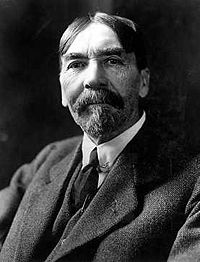 Thorstein Veblen was a professor at the University of Missouri from 1911 to 1918, following stints at Chicago and Stanford and before moving to New York to co-found the New School for Social Research with Charles Beard and John Dewey. Little has been written about Veblen’s time at Missouri, or his relationship with Herbert J. Davenport, who recruited Veblen to Missouri and provided his lodgings. (Veblen is mostly forgotten, locally, but Davenport, who founded the College of Business, is fondly remembered.)
The most detailed account of Veblen’s Missouri years (to my knowledge) appears in Russell H. Hartley and Sylvia Erickson Hartley, “In the Company of T. B. Veblen: A Narrative of Biographical Recovery” (International Journal of Politics, Culture, and Society 13, no. 2: 273-331 — the entire issue is devoted to Veblen). One snippet:
The notion that Veblen’s years in Missouri were a kind of Siberian exile which he spent as an embittered recluse seems more the fancy of academic urbanites than a reflection of actual fact. Dorfman’s puzzling assertion that Columbia “was the first country town where Veblen had stayed for any length of time” contradicts both the facts of Veblen’s life and Dorfman’s own account of those facts. By the time he settled into the Davenports’ at the end of 1910, Thors had lived thirty of his fifty-three years in rural and small-town settings. Columbia was a veritable metropolis compared with Nerstrand or Stacyville and was more than twice the size of Northfield, where he had spent six years attending Carleton.
Veblen’s reported description of Columbia as “a woodpecker hole of a town in a rotten stump called Missouri,” cited by Dorfman as evidence of his “abhorrence” of the place, reflects his wit and mordant sense of humor rather than emotional distress over his physical location. It was an offhand commentary on the local Chamber of Commerce’s campaign to elicit a promotional slogan for the Boone County seat — a remark perfectly in tune with Veblen’s views of business and the commonweal, comprehensible only in light of his analysis of American country towns generally.
Social Science Is For the Asocial?
| Lasse Lien |
I went to a physics seminar the other day. The presenter, an eminent astronomer, made the following remark as he was trying to convey what it was like to work in the natural sciences:
If you hate people and would prefer to do most of your work alone in your office, you should join the social sciences. If you love people and would like to work closely with many others in large research teams, you should join the natural sciences.
The paradox is just beautiful. You self-select to the social sciences because you hate people and want as little as possible to do with them.
More Hoselitz
| Peter Klein |
Since we first inquired about Bert Hoselitz, new information has come to light. First, we hosted a copy of Hoselitz’s hard-to-find 1951 essay “The Early History of Entrepreneurial Theory,” still the best source on the origins of economic thinking on the entrepreneur. Randy has also located Hoselitz’s rare 1963 paper “The Entrepreneurial Element of Economic Development,” which we hope to share soon.
Also, Yvan Kelly published an interesting paper in 2009, “Mises, Morgenstern, Hoselitz, and Nash: The Austrian Connection to Early Game Theory” (Quarterly Journal of Austrian Economics 12, no. 3), which provides more information. Hoselitz attended Mises’s Vienna seminar in 1933 and 1934 and, after Hoselitz emigrated to the US, Mises helped him get a position at Chicago. In 1947 Hoselitz taught a class on international economics at Carnegie Tech, where one of his students was John Nash — the only economics course Nash ever took. Notes Kelly, “there exists the distinct possibility that Nash’s thought process in formulating the [Nash] equilibrium was influenced by Austrian thought.” Kelly goes on to quote Nash’s Nobel lecture: “By coincidence the person who taught the course was someonethat came from Austria. . . . Austrian economics is like a different school than typical American or British. So by coincidence I was influenced by an Austrian economist which may have been a very good influence.” (This article by a famous blogger also deals with the Austrian connection to game theory.)
Coasian or Coasean?
| Peter Klein |
For years I described things relating to Ronald Coase as “Coasian.” Walter Block continually needled me about this, insisting the proper spelling was “Coasean,” but I resisted. Now I see more people using the latter spelling, and I’ve started using it myself. But which is correct? I beats e, but not by much, in a Googlefight. But I think a more targeted crowdsourcing arrangement is warranted. So, dear O&M readers, which do you prefer? Vote below.
Addendum: Thanks to Scott for pointing out that this was debated before at Volokh, where many of the critical issues — and the most obvious snarks — were already presented. To me, the fact that Coase himself, and people at Chicago Law, use “Coasian” seems a pretty strong argument in favor of the non-standard spelling. But one can make a good case for either.
Creative Destruction in Popular Culture
| Peter Klein |
Thanks to Thomas B. for forwarding links to US Sen. Rand Paul’s Monday-night appearance on the Daily Show (part 1, part 2, part 3). At the start of part 3, while discussing government bailouts, Paul uses the words “creative destruction,” and Jon Stewart bursts out laughing, apparently hearing the term for the first time. I guess Schumpeter is not as culturally relevant as I thought!
The show had some interesting moments, but I found the discussions (in the parts I watched) pretty shallow. Stewart was grilling Paul on his “free-market” views, focusing on health, safety, and environmental regulation. Both Paul and Stewart took the milquetoast position that sure, some of this type of regulation is needed, but it shouldn’t be “too much.” They didn’t get into a serious discussion of theory or evidence, however, or explore specific trade-offs. There are huge political economy and public-choice literatures on the FDA, EPA, OSHA, etc., showing that these organizations are easily captured, tend to retard innovation, fail to weigh marginal benefits and costs, and so on. The Journal of Law and Economics under Coase’s leadership made its bones on these kinds of studies in the 1970s. The FDA has been a particular target. The Stewart view also ignores comparative institutional analysis — e.g., the role of private ordering (third-party certification, reputation, etc. ) in the protection of health and safety.
At least Paul didn’t say he intended to become the best Senator, horseman, and lover in all Washington!
Kuhn’s Ashtray
| Peter Klein |
You know about Wittgenstein’s Poker. But have you heard of Kuhn’s ashtray?
We began arguing. Kuhn had attacked my Whiggish use of the term “displacement current.” I had failed, in his view, to put myself in the mindset of Maxwell’s first attempts at creating a theory of electricity and magnetism. I felt that Kuhn had misinterpreted my paper, and that he — not me — had provided a Whiggish interpretation of Maxwell. I said, “You refuse to look through my telescope.” And he said, “It’s not a telescope, Errol. It’s a kaleidoscope.” (In this respect, he was probably right.)
The conversation took a turn for the ugly. Were my problems with him, or were they with his philosophy?
I asked him, “If paradigms are really incommensurable, how is history of science possible? Wouldn’t we be merely interpreting the past in the light of the present? Wouldn’t the past be inaccessible to us? Wouldn’t it be ‘incommensurable?’ ”
He started moaning. He put his head in his hands and was muttering, “He’s trying to kill me. He’s trying to kill me.”
And then I added, “…except for someone who imagines himself to be God.”
It was at this point that Kuhn threw the ashtray at me.
The account comes from filmmaker Errol Morris, then Thomas Kuhn’s graduate student at Princeton, who adds that “I had imagined graduate school as a shining city on a hill, but it turned out to be more like an extended visit with a bear in a cave.” (HT: Pete Boettke). I have not used Kuhn’s particular technique with my own students, though I admit it has a certain visceral appeal. Nor have I been on the receiving end of such behavior, though a conference participant once opened his presentation by saying, “My paper is basically devoted to refuting everything in Klein’s paper.” (Fortunately, I was the moderator, and responded immediately, “Thank you, your time is up.”)
Back to students: I do keep this decorative item by the entrance to my office, placed for all to see:

Joe Mahoney Wins Irwin Award
| Peter Klein |
 Congratulations to O&M friend Joe Mahoney for winning the Irwin Outstanding Educator Award for 2011. The Irwin Award is issued each year by the Business Policy and Strategy Division of the Academy of Management to someone who “(1) has demonstrated outstanding teaching capabilities in business strategy over an extended period of time and the ability to enable future strategy scholars to contribute original research as well as teaching effectively; (2) has had an important impact on strategy pedagogy through demonstrated expertise; and (3) cares deeply about the subject of Strategic Management and the development of his or her students.”
Joe has been my friend and colleague for several years and it’s great to see him join such luminaries as Michael Porter, Mike Hitt, Don Hambrick, Jay Barney, Kathy Eisenhardt, Pankaj Ghemawat, Will Mitchell, and Anita McGahan on the list of Irwin winners.
Anita McGahan at TEDx
| Peter Klein |
Here is my good friend and colleague Anita McGahan, Professor and Rotman Chair in Management and Associate Dean for Research at the University of Toronto’s Rotman School, speaking at a recent TEDx event on the role business schools can play in making the world a better place. Anita is not only a gifted speaker and teacher, and a highly accomplished researcher, but also one of the most thoughtful people in the profession, emphasizing Big Problems as well as the more narrow, technical issues favored by the strategic management literature. Check her out!
New Coase Interview
| Peter Klein |
In conjunction with Ronald Coase’s new book on China, he’s given a new interview to his co-author Ning Wang. (HT: Paul Walker via Mike Giberson.) Excerpt:
WN: You mentioned many times that you do not like the term, “Coasean economics,” and prefer to call it simply the “right economics” or “good economics.” What separates the good from bad, the right from wrong?
RC: The bad or wrong economics is what I called the “blackboard economics.” It does not study the real world economy. Instead, its efforts are on an imaginary world that exists only in the mind of economists, for example, the zero-transaction cost world.
Ideas and imaginations are terribly important in economic research or any pursuit of science. But the subject of study has to be real.
I’m sympathetic to this, but with some methodological reservations, expressed at the end of this post. Anyway, the interview focuses on China, its future economic prospects and likely influence, and the newly formed Coase China Society. Coase is bullish on China: “In the past, economics was once mainly a British subject. Now it is a subject dominated by the Americans. It will be a Chinese subject if the Chinese economists adopt the right attitude.” (more…)
CFP: Hayek and Behavioral Economics
| Peter Klein |
Forwarded on behalf of Roger Frantz:
CALLL FOR PAPERS
“Hayek and Behavioural Economics” (2011). Palgrave Macmillan. Vol 4 of Archival Insights into the Evolution of Economics. Robert Leeson Series Editor. Vol 4 editors, Roger Frantz and Robert Leeson.
Papers on all aspects of Hayek’s work as it relates to behavioral economics defined broadly which includes but not limited to economics and psychology, neuroeconomics, and topics in the history of economic thought.
Papers will be due by the summer of 2011. Send inquiries and an abstract to Roger Frantz (rfrantz@mail.sdsu.edu) or Robert Leeson (rleeson@stanford.edu).
The Economist on Coase at 100
| Peter Klein |
 The new Economist celebrates Ronald Coase’s 100th birthday (this coming Wednesday) with a short piece on “The Nature of the Firm” (1937), the founding document of modern organizational economics (16,379 Google Scholar cites). (Thanks to Avi for the pointer.) It’s nice to see the theory of the firm get its props, and the first few paragraphs do a good job summarizing the paper. But the (anonymous) author has misread the modern literature, first in setting up an artificial conflict between Coase’s transaction-cost approach and the resource-based approach to the firm and, second, by missing the depth and nuance of Coase’s own research program.
 On the first point: Much recent work tries to reconcile transaction cost economics (TCE) and the resource-based view (RBV) (e.g., Silverman, 1999; Foss and Langlois, 1999; Tsang, 2000; Madhok, 2002; Foss and Foss, 2005), pointing out that the two theories are, in important ways, complementary. Put simply: TCE and RBV start with different explananda. The RBV asks which resources will be combined in which ways to produce which outputs, while TCE asks how this activity will be organized (market, hierarchy, or hybrid). RBV offers a theory of competitive advantage, while TCE focuses on boundaries and governance. Second, the Economist writer confuses Coase with the (Coase-inspired) transaction cost approach of Williamson (1971, 1975, 1979) and Klein, Crawford, and Alchian (1978): (more…)
“Robert S. McNamara and the Evolution of Modern Management”
| Peter Klein |
That’s the title of a new HBR article by Phil Rosenzweig (author of the excellent Halo Effect). I’ve been interested in McNamara and his role in business history since grad school, when I was researching “management by the numbers” and similar techniques that flourished during the conglomerate boom in the 1960s. (See previous O&M posts on McNamara here and here.) Rosenzweig provides a nice summary of some of strengths and weaknesses of McNamara’s dispassionate, “rational,” quantitative approach (see especially the sidebar, “What the Whiz Kids Missed”). Lots of information and ideas related to decision theory, organizational design, multitasking, performance evaluation, innovation, etc. Excerpt:
Whether at Ford or in the military, in business or pursuing humanitarian objectives, McNamara’s guiding logic remained the same: What are the goals? What constraints do we face, whether in manpower or material resources? What’s the most efficient way to allocate resources to achieve our objectives? In filmmaker Errol Morris’s Academy Award–winning documentary The Fog of War, McNamara summarized his approach with two principles: “Maximize efficiency” and “Get the data.”
Yet McNamara’s great strength had a dark side, which was exposed when the American involvement in Vietnam escalated. The single-minded emphasis on rational analysis based on quantifiable data led to grave errors. The problem was, data that were hard to quantify tended to be overlooked, and there was no way to measure intangibles like motivation, hope, resentment, or courage. . . .
Equally serious was a failure to insist that data be impartial. Much of the data about Vietnam were flawed from the start. This was no factory floor of an automobile plant, where inventory was housed under a single roof and could be counted with precision. The Pentagon depended on sources whose information could not be verified and was in fact biased. Many officers in the South Vietnamese army reported what they thought the Americans wanted to hear, and the Americans in turn engaged in wishful thinking, providing analyses that were overly optimistic.
Palgrave Entry on Oliver Williamson
| Scott Masten |
If you have access to The New Palgrave Dictionary of Economics, Online Edition, my entry on Oliver Williamson is now available: Oliver E. Williamson.
Prahalad Conference
| Peter Klein |
 My colleague Karen Schnatterly, along with Bob Hoskisson and M. B. Sarkar, are organizing a special SMS conference to honor the late C. K. Prahalad. It’s 10-12 June 2011 in San Diego. The conference “will bring together scholars, executives, and consultants who have researched or applied CK Prahalad’s ideas. There will also be a number of panel sessions that include individuals such as Gary Hamel, Yves Doz, and Stuart Hart.” Proposals are due 21 January 2011.
Report on the North Conference
| Peter Klein |
 Responsibilities abroad kept me from attending the recent Douglass North celebration, but the University of Missouri was well represented by a group of energetic and enthusiastic PhD students, who sent me the following report:
The conference on Legacy and Work of Douglass North was an outstanding meeting with discussions on the past, present, and future of the New Institutional Economics. Top scholars discussed the contribution and influence of North (and the New Institutional Economics) in a diverse range of fields, covering everything from the impact of the initial contributions to the outlook for continued research.
It’s hard to summarize the insights and contributions from six paper sessions, Elinor Ostrom’s keynote, and the roundtable on North and the Rise of the New Institutional Economics. One takeaway was the depth and breadth of North’s contributions – many speakers were North coauthors working on a wide variety of topics, from many different perspectives (economics, political science, history, cognition, etc.). North’s influence is huge across the social sciences.
One burning issue: what’s the next step for New Institutional Economics? Besides bridging or integrating Northean institutional analysis with Williamsonian organizational economics, many speakers emphasized the need to be more rigorous, to examine more details, to go farther than the “big picture” studies that are so prominent in the field. There are too many grand, sweeping claims, and not enough mundane, middle-of-the-road analysis. (John Nye, for example, expressed concern that some Northean ideas are very difficult to operationalize, a particular problem since younger scholars are confronted with very high standards for formalization, empirical technique, etc.) (more…)
Influences
| Scott Masten |
Oliver Williamson has obviously had an enormous influence on my research and career, but I encountered Olly only fairly late in my education; in fact, I didn’t take Olly’s Industrial Organization course until my last semester of course work, in the fall of my third year in graduate school. Prior to that, my primary field had been comparative economic systems or, as it was called at Penn, comparative economic planning. My interest in the latter field and, indeed, my decision to go to graduate school in the first place I owe to Edwin Dolan. I had entered college intending to go to law school and enrolled in Dolan’s Economic Analysis of Law seminar in the winter of my sophomore year. That course was eye-opening for me in two respects. First, after spending long days in the library stacks reading law cases (when the next best alternative activity was skiing), I decided that that was not what I wanted to do for the rest of my life. Second, I learned that I could engage the “fun” (that is, the analytical) part of law by continuing in economics, which I already found appealing. (more…)





 Organizations and Markets
Recent Comments